|
Mother Courage
and her
Children
by Bertolt
Brecht

BERTOLT BRECHT (1898-1956)
Bertolt Brecht's fame
continues to increase both as a great dramatist, and
as a leader in thought, stagecraft theory and
practice. He was born in Augsburg, Germany and
studied medicine and the sciences before embarking
upon his literary career. During World War I he
began writing poems, short stories and reviews for
the Augsburger Volksville. He later became a stage
director for the Kammerspiele Theatre in Munich. For
the Kammerspiele, which was his first contact with
theatre, he wrote several plays. During the period
he was with Max Reinhardt. Brecht's first successful
play was "Drums in the Night" (Munich 1922), which
was presented throughout Germany until 1933 when the
association with Reinhardt terminated. The years
with Reinhardt were productive, with such plays as
"In the Cities," "Edward II," "A Man's a Man," and
"The Threepenny Opera." "The Threepenny Opera" was
presented in 1928 at the "Am Schiffbauredamn"
Theatre and has since been filmed and played
successfully throughout the world. Brecht left
Germany in 1933, not to return until 1949 when he
established his famous Berliner Ensemble Theatre.
The first play at the Berliner was "Mother Courage
and Her Children," written in 1938. The Berliner
Ensemble Theatre is still active today. It is
directed by actress Helene Weigel, Bertolt Brecht's
wife. Along with "Mother Courage and Her Children,"
other plays presented were and are "Galileo,"
"Trumpets and Drums," "The Caucasian Chalk Circle,"
"Cariolanus" and "The Good Woman of Setzuan."
Brecht's formidable reputation as a director and
leader in the theory and practice of stagecraft keep
his books "Theaaterarbeit," "The Little Organum for
the Theatre" and "Dialektik auf dem Theatre" among
the most important in dramaturgy.
In the early
seventeenth century, Germany consisted of small
secular and ecclesiastic states, independent duchies
and independent cities, all of these part of the
Holy Roman Empire under the rule of the Habsburgs.
The countries that were then the Holy Roman Empire
are today parts of Germany, France, Italy, Poland,
Yugoslavia, Czechoslovakia, and the whole of
Belgium. The Thirty Years War (1618-1648) was a
religious struggle between the Protestant Princes of
Northern and Middle Germany and Catholic Germany
headed by the Habsburg Emperor. Gustavus Adolphus of
Sweden championed the Protestant cause while France
intervened in favor of the Catholics. More than half
of the German nation was wiped out in the Thirty
Years War, one of the most disastrous in all
history.
PART 1
SCENE 1
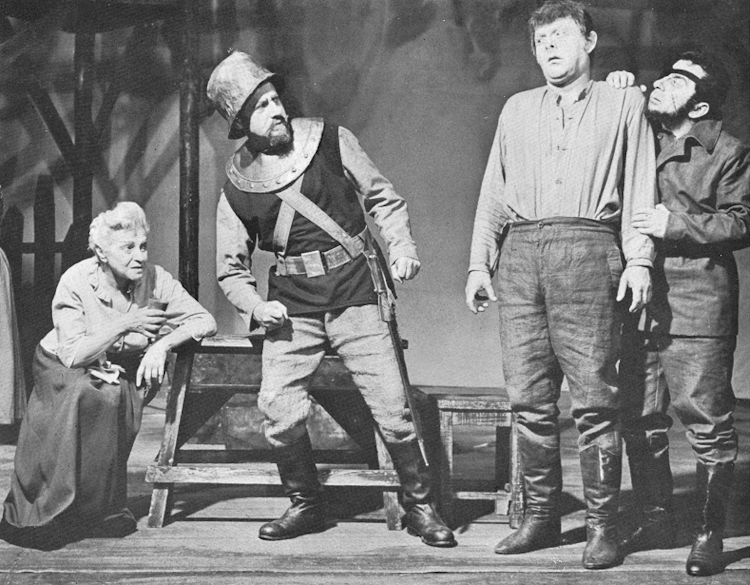
During a discussion on
the open road between a feldfebel1 and a recruiting
soldier who have waylaid a victim, they agree that
war brings discipline and order to life, while the
only benefit of peace is disorder. A wagon appears
with Mother Courage and her sons, Eilif and
Szwejcerkez, and her mute daughter, Katrin. The
feldfebel demands identification from the entourage,
there is none, but he is only interested in the
recruitment of the sons. Mother Courage, in the
attempt to save her sons, omens the death of the
feldfebel. In a drawing as to who will die, Eilif
and the feldfebel each draw a card with a black
cross, the sign of death. While haggling is going on
about a purchase, the recruiting soldier takes Eilif
and Mother Courage sighs: "The one who wants to make
a penny on war has to give it something also ..."
SCENE II -- POLAND
1629
A Swedish commander
praises Eilif for stealing cattle from the peasants.
Eilif sings a song about the wife of a soldier who
wishes to prevent her husband from going to war, and
Mother Courage joins in the last part of the song
about the miserable end of a soldier. Mother Courage
tells her guests, a cook and a chaplain who feels
that this war is justifiable, that if the Poles had
not interfered, the King of Sweden would not have
entered the war. The cook declares that it is always
the poor who bear the cost of the war, although the
King of Sweden has God on his side because he is
defending the faith.
As the Catholic Army
appears, Mother Courage smears her daughter's face,
the chaplain hides the Protestant flag and asks for
civilian clothes, and Szwejcerkez hides his
regiment's money. Mother Courage has been accepted
by the Catholics as a sutler, the price of the
bargain being more important than her faith. As
spies come in with Szwejcerkez, Mother Courage
pretends not to know him. With the aid of Ivette, a
friend of the colonel, to whom Mother Courage has
pawned her wagon, she hopes to ransom her son. While
arrangements are being made to give up her wagon,
her only source of income, Szwejcerkez's body is
brought in to be identified, Mother Courage
renounces her son to save Katrin's and her own life.
SCENE III -- POLAND
-- POMERANIA, 1625-1626
Mother Courage buys a
sack of bullets from an armorer. Now a treasurer
with a Finnish regiment, Eilif is told by his mother
to keep warm and to be honest. Ivette talks about
her first lover, Peter the Pipe, a cook and sings a
song about fraternity.
PART II
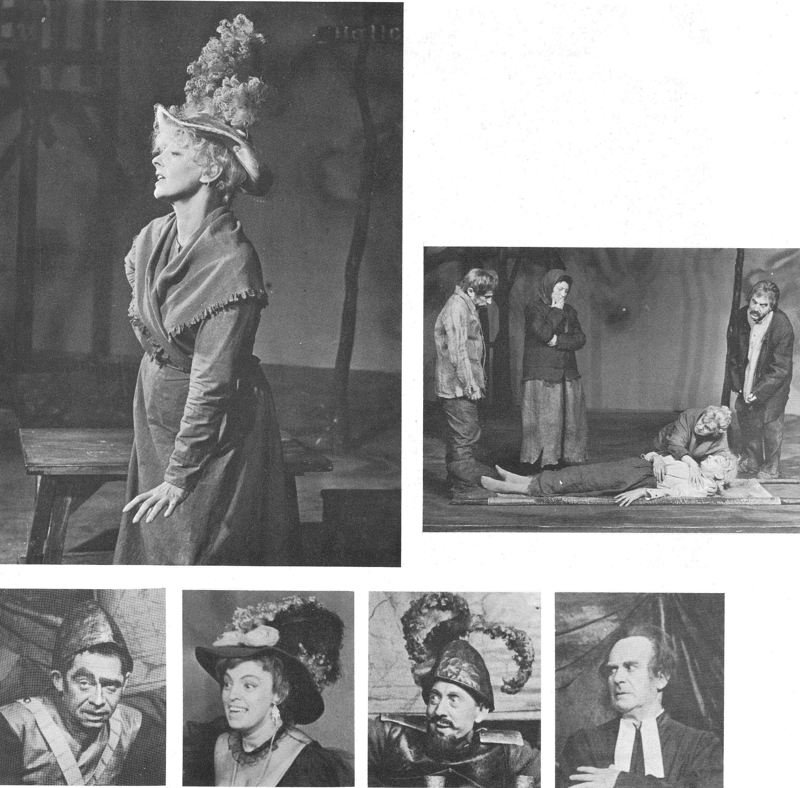
SCENE IV
Mother Courage is
being searched by Catholic soldiers and hopes to
register a complaint about them to their captain. A
soldier who sees the captain keep some of his own
reward threatens the captain with death. Mother
Courage has a feeling that the soldier will not help
her in any way, so she dismisses her complaint to
the captain. She sings "Great Capitulation" about
the disappointments of common people who dream about
a happy future, but who know that only misery awaits
them.
SCENE V
As the Catholic
General Tilly is being buried, Mother Courage
examines her merchandise. She is told by the
chaplain that the war need not end, and that only
during war can common people satisfy their needs,
thus she sends Katrin to town for new supplies. As
Katrin returns attacked and mutilated, a cannonade
is heard commemorating General Tilly's burial, which
the chaplain calls a great historic moment. To
Mother Courage this great moment only means Katrin's
misery and another reason for cursing the war.
SCENE VI -- 1632
Mother Courage has now
become rich, and to her the war has become a source
of her livelihood. She does not wish the war to end.
SCENE VII -- 1632
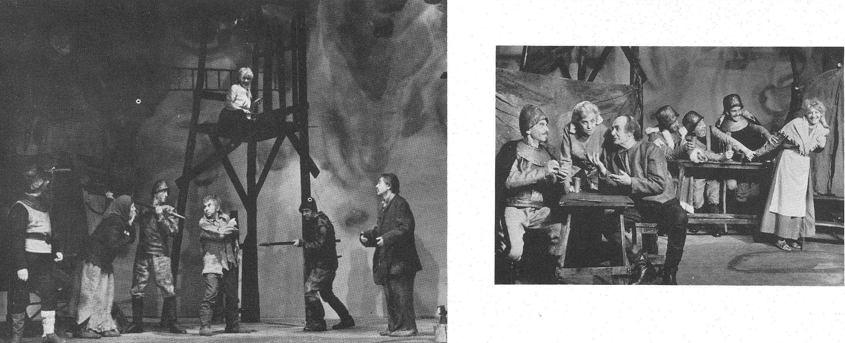
As a poor artisan and
his mother are about to sell Mother Courage their
last pillow, tolling bells announce the death of
King Gustavus Adolphus. The cook who had run away
from the Swedish Army announces that Eilif would be
returning soon. To the cook and Mother Courage, the
coming of peace only means misfortune. The chaplain
who is being berated by her for having encouraged
her to buy useless merchandise calls Mother Courage
"a hyena waylaying the loot." Ivette, who comes to
see Mother Courage, recognizes the cook as Peter the
Pipe and warns her against him. Mother Courage
decides to sell her wares.
Eilif is being led to
his execution for attacking the peasants and
stealing their cattle. This is permissible during
war, but not in peace time.
Mother Courage returns
from town with the good news that the war is
continuing, and in spite of Ivette's advice takes on
the cook as her partner.
SCENE VIII -- SAXONY 1634
In front of a
parochial house the cook receives word that his
mother has died and left him an inn in Holland.
Mother Courage, who had been asked by the cook to be
his partner, is overjoyed. She has always prayed for
her own home. However he will not want Katrin. He
and Mother Courage sing a song about King Solomon to
evoke the pity of the dwellers in the parochial
home. Katrin, who knows how the cook feels about
her, decides to run away. This makes Mother Courage
decide not to go with the cook and never again
accept a partner.
SCENE IX
Mother Courage and her
daughter harness themselves to a wagon, and as they
travel through the villages they hear songs about
the bliss of a quiet domestic life, but they
continue further.
SCENE X -- SAXONY
1635
Mother Courage has
gone to Halle and has left Katrin with peasants.
Catholic soldiers have captured a young peasant who
is to show them the way to the town. If the peasants
of the town refuse to cooperate with the soldiers,
their cattle will be slaughtered. The peasants pray
for mercy. As Katrin hears the prayers, she ascends
to the roof of a house and begins beating the drums
and awakens the guards. As the soldiers try to stop
Katrin, a young peasant encourages her. A bullet
pierces Katrin's body and she falls dead. The whole
town is awake and bells begin to toll. Katrin has
accomplished her aim.
SCENE XI
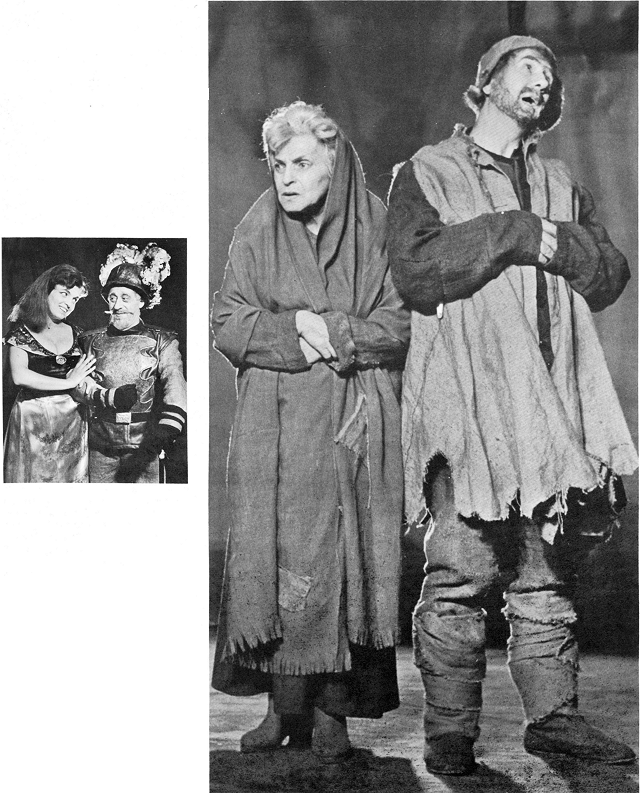
As Mother Courage
laments her daughter, she is blamed by the peasants
for her greed. If she had not left her daughter, she
would not have died. Mother Courage gives the
peasants money for Katrin's burial but harnesses her
wagon and continues with the only life she knows.
Onward she goes, as she follows the marching troops
who, with her, are singing the last stanza of the
song.
1
-- A feldfebel was a type of
non-commissioned officer. |

