|
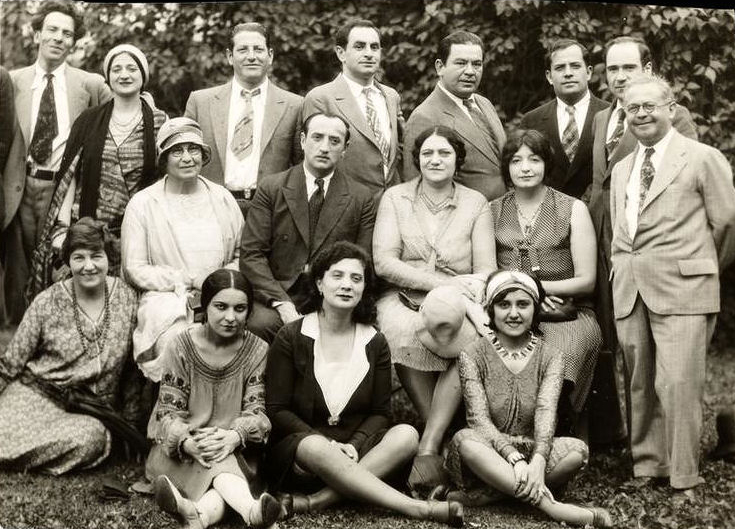
All identifications are made left to right. Back row, standing: Lazar Freed, Celia Adler, Morris Silberkasten, Anatol Winogradoff?, Izidor Casher, unk, Morris Strassberg, unk. Seated on bench: unk, Maurice Schwartz, unk, unk. Seated on ground: Unk, unk, Berta Gerstin, unk. From Martin Boris' unpublished biography of Schwartz entitled, "Once a Kingdom": The Art Theatre spent most of the summer in London, at His Majesty’s Theatre in Haymarket, where the best English plays from Shakespeare to Noel Coward were presented. At first, their reception was invigorating, the British mainstream critics very favorably impressed with Yoshe Kalb—not as great literature, but as spectacle (as were their American counterparts). One English reviewer described it as “a magnificent piece for the theatre [. . .] brilliantly expressive.” He reported that “the demand for curtain calls even drowned out the playing of the national anthem afterward” (Times 31 July 1935). When in London, do as the Londoners. Since its better drama critics would attend premieres and spend an inordinate amount of the intermission at the playhouse bar, so did Schwartz. He was no tippler, but he did so want to win over the press, all in the service of his Art Theatre. Whether the hail-fellow-well-met routine paid dividends, Maurice would never know for sure, except he did receive universal raves from the staid London Times, and the trendier Daily Examiner and Daily Herald. With the arrival of fall, interest in Yiddish Theatre slowly petered out in London. Maurice blamed the unexpected slack on the assimilation of London Jews into the general society. Perhaps a tour of the English hinterlands might reverse the Art Theatre’s fortunes, just as a summer tour in America had always been good medicine for the spirit and the bank account. Relkin booked them into Leeds and Manchester, where they bombed badly. “Both cities have synagogues, cantors and rabbis. Their Jews observe tradition by preparing gefilte fish for the Sabbath. They collect charity for Palestine—not too much, but every little bit helps. However, Yiddish Theatre for them was an alien concept” (Schwartz 22 Aug. 1945).
|
|
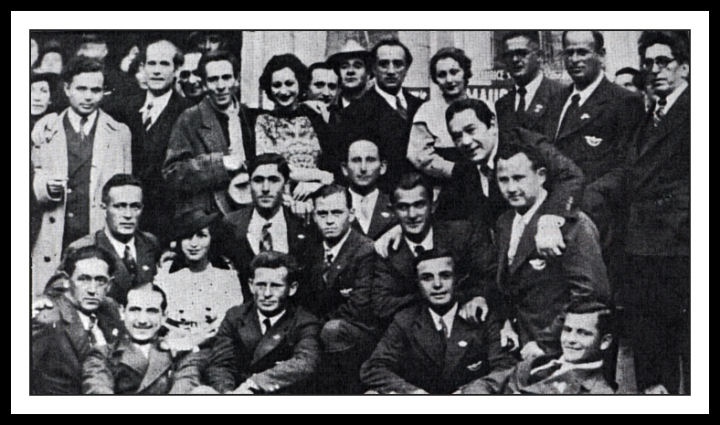
Standing: Ben Zion Katz, Michael Gibson, Lazar Freed, Charlotte Goldstein, Martin Schwartz, Moishe Strassberg, Maurice Schwartz, Judith Abarbanel, and (to the extreme right) the manager Edwin A. Relkin. Isidore Casher is the one with his arms around the two soccer players. Paris, France. From Martin Boris' unpublished biography of Schwartz entitled, "Once a Kingdom": “Paris: the city of enchantment and glamour. France: the country of liberty, equality and brotherhood. Who didn’t wish to be here at least once in life? The magic city with its broad boulevards, where people sit in coffeehouses and drink wine and listen to music” (Schwartz 7 Mar. 1942). They arrived nearly broke, only $10 of the loan remaining. The French press and representatives of every major Jewish organization were waiting at the train, but very formally, and even a tad cold compared to the English. The Paris Theatre held only 600 seats, which when filled brought in no more than $380. Its stage was too small for the elaborate sets Schwartz had lugged from America, but despite the obstacles and lack of funds, the Art Theatre was resoundingly successful. In addition, Schwartz met the leading intellectuals and artists of Europe, among them the poet and writer Zalman Schneour, who penned the novel Noah Pandre, about a Jewish ruffian. Schneour could have been taken for some Italian prince: tall, elegant, with intensely dark eyes and a neat black beard. As in London, the Art Theatre’s income hardly covered outgo. Schwartz rapidly fell in debt to his actors, an intolerable situation he’d pay for dearly after they were back in the States. Money woes made Schwartz’s two weeks in Paris long and tormenting. Often, he and the troupe had to depend on the kindness of others, better-off French Jews and American visitors, to treat them to dinner. Thrilled when he’d arrived in Paris weeks before, he was even more elated leave. Like many a would-be conqueror, he left somewhat disenchanted. |
|
Yiddish Art Theatre Company
at the grave of Dr. Herzl in Vienna: B. Gorin, the historian
of the Yiddish Theatre, From Martin Boris' unpublished biography of Schwartz entitled, "Once a Kingdom": Vienna was also a city of art, music, gaiety and first-class restaurants, but with Germanic stolidness. Schwartz’s advance man had booked the tradition-encrusted Karl Theatre on the Praterstrasse for their performances. It was Vienna’s leading opera house, where the music of Strauss, Kalman and Franz Lehar had delighted the Austrians. The Karl had a large stage, suitable for the Yiddish Art Theatre’s more gaudy productions. Schwartz felt better about this and took it as an omen of better times to come. For filming "Yiskor," the Schonbrunn had been rented. Formerly one of Emperor Franz Josef’s castles, the Schonbrunn had become a movie studio after the war, and was surrounded by magnificent gardens, where between scenes, the actors could meander and inhale the scents of roses and muguet. During their short stay in Vienna, the troupe worked exceptionally hard: evenings at the Karl, days before the cameras at the castle. They were well-paid, and in American dollars. Maurice used many of his own players for the film, integrating them with Austrian actors such as Oscar Beregi, Fritz Strassny, and the particularly lovely Dagny Servaes. |
|
|
|
|
Copyright © Museum of the Yiddish Theatre. All rights reserved.