|
ANGELS ON EARTH1,
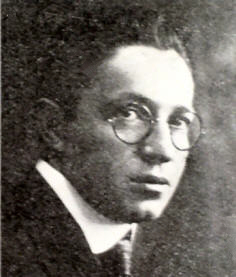
by Chone Gottesfeld
So, here is the synopsis of Gottesfeld's "Angels on Earth". Time -- The Present. A lapse of six months between the fourth and fifth scenes. The name of the actor or actress who portrayed a particular role is indicated within parentheses: SYNOPSIS PROLOGUE Dr. Mars (Mark Schweid) gives a public demonstration of a new invention of his, an extraordinary radio apparatus which makes it possible for inhabitants of the earth to observe what is going on in the other world, and in particular to see and hear their departed ones. Being in good humor because his wife has just presented him with twins, he is willing to let the audience survey the other world for less than the regular rates. On getting enough customers he proceeds with the demonstration, and in a trice we are transported to the other world -- naturally to Hell, the only place persons of our sinful age may expect to go when they die. Hell is no longer what it used to be. It has been modernized. Gone are the traditional horrors of Hades; instead of being tortured, those consigned to the infernal regions nowadays enjoy every pleasure imaginable. The old become young, the ugly beautiful, the poor rich, and life is an endless round of enjoyment. The dead eat and drink and dance and play all kinds of games and make love to their hearts' content; they sleep forty-two hours a day; they attend shows, concerts, baseball games, prize fights, debates, lectures --the only torture left in Hell -- and listen to the radio, which brings them not only the music of the spheres, but also of the earth. Why, they even have "Jewish Hour" down there. For these startling innovations in Hell the credit is due to two angels, Shamsiel (Maurice Schwartz/Lazar Freed) and Zafziel (Samuel Goldenburg/Jacob Mestel), who also provide the endless entertainments. The first scene is a beauty parlor. Here we see Grandma (Bina Abramowitz), who when alive used to sell pickles on the lower East Side, stylishly dressed and having her nails manicured by a young girl (Sonia Cutler), who charges nothing for her services. And when Grandma departs, the manicurist's sweetheart (John Wexley) enters and soon shows us that he has not forgotten the earthly ways of a man with a maid. The scene now shifts to one of Hell's innumerable amusement halls, each built to accommodate ten persons. The first to arrive are Moses (Morris Strassberg) and Israel (Pincus Sherman). When the ushers (Hyman Wolkoff and Biltchinsky) ask them for their tickets, they indignantly remind them that they have perpetually reserved seats. Presently they are joined by a fresh arrival from New York (Joseph Greenberg), where he was a customer peddler. His chief vice while on earth, he confesses to Moses and Israel, was making love to housewives in order to get them to buy his wares. Mr. and Mrs. Soskin (Michael Gibson and Anna Appel) enter next. Mr. Soskin recognizes the peddler as one who back on earth once offered to elope with her, if only she would buy a vacuum cleaner from him. The peddler fears her husband's wrath, but in the new Hell husbands are not jealous. Grandma arrives, leaning on the arm of her escort, a dashing young fellow.
Music begins to
play, whereupon the peddler proceeds to eat a
sandwich, as he used to do on similar occasions
back in New York. Mendel Flam (Jacob Mestel),
the stage manager, appears and in preposterously
stilted language announces the program of the
entertainment. First comes a ballet from
Goldfaden's musical comedy, "The Tenth
Commandment," as produced by Maurice Schwartz.
Then Sarah Bernhardt appears in a scene from
Gordin's "Mirele Efros." Snatches of the "Jewish
Hour" of Station WMCK are heard next, but the
audience does not seem to care for the fare that
hour offers. Thereupon Flam introduces Hell's
most popular stage artists, Shamsiel and Zafziel. The angels
sing a duet and then proceed to address the
audience. They recite the many reforms they have
introduced whereby Hell has become a most delightful place, and enjoin all present not to reveal
this fact to their living relatives when they
appear to them in dreams, lest the earth be
overrun with sin. At this point the speakers are
interrupted by a telephone message from the
archangel Gabriel, who commands them to get
ready at once to fly to the earth and repair to
New York. The earth, and especially New York, is
full of sin, and they must try to reform it. Shamsiel and Zafziel beg to be excused from so
disagreeable a mission, but neither their pleas
nor Grandma's threats to go on a hunger strike
are of any avail. Thereupon the two angels fly
to the earth in an airplane.
INTERMISSION -- 5
MINUTES SCENE ONE The home of Milk (Gershon Rubin), an insurance agent. We see him and his friend Water (Lazar Freed/Mark Schweid), the proprietor of a cafeteria, eating sandwiches. This is all they have to eat as their wives, Fannie (Berta Gerstin) and Annie (Stella Adler) respectively, are too busy attending bridge parties, automobile and dog shows to do any cooking. The two husbands bewail their lot, which has lately been aggravated by the intrusion into their lives of two strange men, the one a teacher of singing and the other a piano teacher, named respectively Fiddle (Maurice Schwartz) and Lyric (Samuel Goldenburg/Lazar Freed) (who are none other than Shamsiel and Zafziel in human guise). Fannie and Annie dote on these men who Milk and Water keep on urging each other to put a stop to so scandalous a situation and to assert their rights as husbands. Milk, true to type, does not overlook the main chance, and between commiserations tries to sell Water an insurance policy. Water agrees to take out one if Milk will drive Fiddle out of his house and promises on his part to do the same to Lyric. Exit Water and enter Fannie. Milk, whose name bespeaks his courage, tells Fannie that Water has just told him he had ejected Lyric from his home. Fannie is all indignation and reviles her husband when he ventures to defend his friend. Milk leaves for the barber shop. As he goes out, Annie enters and eyes him angrily, her husband having told her that Milk had just driven Fiddle out of his house. She and Annie compare notes and suspect that their husbands are up to something. Annie leaves, and presently Fiddle enters and inquires after the whereabouts of Milk, he and Lyric having always exhorted Fannie and Annie not to permit their husbands to go out alone. He feels reassured when he learns that Milk has gone for a shave. But his composure soon forsakes him when Fannie begins to make overtures to him and he declares that a man ought to shave himself. He heaves a sigh of relief when Milk returns. The latter insults Fiddle, which causes Fannie to fly into a rage. Fiddle defends Milk, which leads Fannie to upbraid her husband all the more for offending so good a man. Milk is implacable and shouts that either Fiddle will leave the house or he will do so himself. Fiddle is ready to go, whereupon Fannie threatens to commit suicide. Milk knows she is bluffing, but Fiddle promises not to go away. Thereupon Milk leaves the house in disgust.
Annie and Lyric
enter and Annie tells of a similar scene between
her and her husband which likewise ended in the
latter leaving her. While the two enamored women
exchange confidences, the angels in disguise,
fearing lest they succumb to the temptations of
the flesh and share the fate of the fallen
angels, the Nephilim, vow never to leave each
other, as two are stronger than one. For further
strength they chant the angels hymn. Milk and
Water come in and make peace overtures to their
wives, but the latter declare that they will
father go to work than go back to their prosaic
husbands: Milk and Water leave, this time for
good, it being understood that they are to
divorce their wives. After a whispered
conference Fiddle and Lyric tell. Fannie and
Annie that they need not go to work. Instead,
they, the two angels, will give up their music
and become factory workers, support Fannie and
Annie, and set up a home where the four of them
will live together.
Fannie and Annie,
like the Canadians Mounted, got their men.
Having been divorced by their husbands, they
married Fiddle and Lyric respectively. But to
their chagrin, their new husbands, who in every
other respect are all one could desire, do not
in one vital respect behave after the manner of
husbands. In short, the marriage in each case
has not been consummated. As a last resort they
try to awaken their husbands' interest by
arousing their jealousy. Accordingly, they
invite for dinner at their home Lucus (Izidor
Casher) and Hammer (Louis Weisberg), two butter
and egg men from Washington, D.C., with whom
they have struck up an acquaintance at Rockaway.
In their husbands' presence Fannie and Annie
"neck" with their guests, but the moment Fiddle
and Lyric step out to fetch some beer at the
neighborhood speakeasy, they become staid and
frigid. This leads Lucus and Hammer to suspect
that they are being made the victims of a badger
game and various complications follow. But
finally the misunderstanding is cleared up and
all sit down amicably to dinner.
Fiddle and Lyric
arc alone in their bedroom, for in fulfillment
of their vow never to leave each other's side,
they sleep together. Fiddle sighs because Fannie
and Annie are still out with Lucus and Hammer,
though it is now 3 A. M. Both angels are
homesick for Hell. Fiddle fears he will never
see dear old Hell again, for he has sinned.
Pressed for an explanation by Lyric, he
confesses that the night before, driven by
desire he entered his wife's bedroom and gazed
at her and Annie's loveliness. He further
confesses that he felt terrible pangs of
jealousy when Fanny and Lucus were kissing.
Lyric exhorts him to be strong and suggests that
they sing again the angels hymn. At this point
the laughing voices of Fannie and Annie and
their gentlemen friends are heard outside.
Fannie, Annie,
Lucus, and Hammer are having a snack in the
dining room and recounting their adventures that
night in various cabarets. Lucus and Hammer are
reluctant to leave, thinking that this is no
fitting end for such a perfect day, but when
they find that they must go, they each try to
snatch a kiss by way of parting. A cry is heard
and Fiddle and Lyric rush into the room in their
pajamas. At the sight of the enraged husbands,
Lucus and Hammer flee. And the two angels yield
to the charms of their wives. INTERMISSION -- 8 MINUTES
0ur angel heroes, having chosen to follow the way of all flesh, do so thoroughly. They become fathers as well as husbands, and also have mistresses. They leave the shop and become businessmen, realtors. On one of their lots in New Jersey they strike oil, and at once set up a corporation in competition to the Standard Oil Company. The principal stockholders are Fiddle and Lyric, Lucus and Hammer, and Milk and Water, the last two owning fifty percent of the stock. As the curtain rises we see Fiddle and Lyric installed at a wayside gasoline station which also serves as the headquarters of the new oil corporation. The two are so engrossed in business that they have no time for their wives, and when the latter complain, they advise them to go to bridge parties, automobile and dog shows.
Lucus and Hammer
enter and bring word that Senator Lucus is
willing to pay a quarter of a million dollars
for a fifty-percent interest in the concern. The
only way this could be done is to buy back the
stock which Milk and Water hold, and for which
they paid only $5,000. But as Milk and Water
refuse to part with the stock, they must recover
it from them by hook or crook. Accordingly Lucus suggests that Milk and Water be invited to
a party at a Harlem cabaret that evening, on the
pretext that this was the birthday of Fiddle and
Lyric, and that they be asked to bring their
shares with them. Once in the cabaret, it would
be an easy matter to put knockout drops into
their drinks and rob them of their stock. Lyric
protests, but Fiddle, who has shed all traces of
his former angelic nature, approves of the plan. SCENE SIX
At a Negro cabaret
in Harlem. When the party is seated at the
table, Fiddle by mistake puts the knockout drops
into the glasses of Lucus and Hammer, instead of
those of Milk and Water. When Lucus and Hammer
fall unconscious, Milk and Water suspect foul
play, and guessing that the drops were intended
for them rather than for the actual victims,
they summon the police. SCENE SEVEN
In prison, where
Fiddle and Lyric are awaiting their trial. Both
are despondent and Fiddle expresses doubt that
there is a God, for if there were a God, would
He have permitted them to come to such a pass?
Fannie and Annie come to visit their husbands.
Both say that their former husbands, Milk and
Water, are now enormously rich and are willing
to take them back. Accordingly Fannie and Annie
ask their present husbands to give them their
freedom, which the latter promise to do. After
the women leave, Fiddle is heartbroken at the
loss of Fannie. Lyric implores God to forgive
him and his fellow angel their transgressions
and to take them away from this wicked world;
but Fiddle is most reluctant to leave the earth.
At last a voice from heaven is heard saying that
the prayer of Zafziel (Lyric) has been granted,
and that an airplane will soon come to fetch
them back to Hell, where they will be judged for
their deeds while on earth. EPILOGUE The scene now shifts to Hell. The archangel Michael is presiding at the trial of Shamsiel and Zafziel (Fiddle and Lyric). Mendel Flam is the prosecuting attorney, and Mrs. Soskin is counsel for the defense. After counsel for both sides state their cases, Grandma and the others present plead for the accused angels. Finally Michael calls upon the accused to speak for themselves. Fiddle speaks first and outrages all his friends by saying that come what may, he will always insist that life on earth is more interesting than life in Hell, however reformed. Accordingly, he implores Michael that he be transformed from an angel into a man and sent back to earth. And strange to say, Lyric now rises and makes the same request on behalf of himself. Grandma and the others soundly berate the renegade angels. Finally Michael renders judgment. In view of the fact that Lucus and Hammer have recovered, and that Milk and Water have married, not Fannie and Annie, but Gentile women, he grants the pleas of Fiddle and Lyric and decrees that they cease to be angels and become men pure and simple, and that they be sent back to earth at once.
|
||||
|
Executive Staff: Martin Schwartz, Manager; Oliver M. Sayler, English Press Agent; Leon Hoffman, Yiddish Press Agent; Lewis Kasten and Irving L. Cone, Treasurers, Anne Bordofsky, Manager Subscription Dept. Stage Staff: Boris Aronson, Scenic Director; Jacob Mestel and Ben-Zion Katz, Stage Managers; Joseph Schwartzberg, Librarian; George Tueller, Musical Director. Technical Staff: William Mensching, Master Carpenter; Chris. Logan, Master Electrician; Rudolph Pfeiffer, Master Properties; Israel Misbin, Superintendent.
|
||||
|
1 -- Maximilian Hurwitz. Playbill for the Yiddish Art Theatre's production of "Angels on Earth", Introductory notes, 1929. Courtesy of YIVO. |
|
|