|
THE BROTHERS ASHKENAZI1,
by I. J. Singer
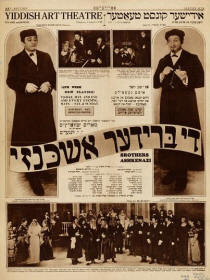
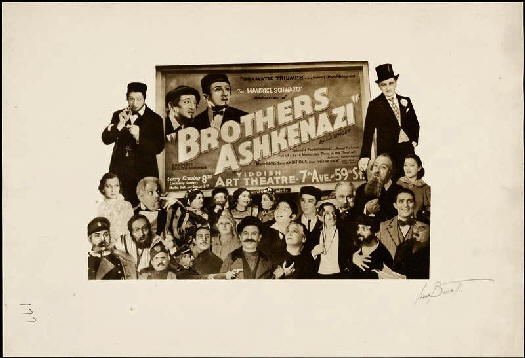
So then, here is the synopsis of Singer's "The Brothers Ashkenazi". The name of the actor or actress who portrayed a particular role is indicated in parentheses: SYNOPSIS PART ONE Scene 1: The action starts in the early part of the nineteenth century, after Napoleon's retreat from Russia by way of Poland. The industrial city of Lodz which subsequently became known as the Manchester of Poland, was a mere village at that time with a handful of Jews living in a separate Jewish quarter. The Jews--artisans and small traders--are startled one day by the appearance of several hundred covered wagons at the village gates. The entire population gathers in the tavern to meet the newcomers. Several Germans appear. Their leader, the youthful Heinz Huntze (Kurt Katch), tells them that they had been invited by the Russian government to develop the textile industry in the land, and that the Jews will not be permitted to import textiles of foreign manufacture anymore. The Jews are disturbed by the news. Johanan Ashkenazi (Julius Adler), the head of the nearby Jewish community of Lentchitz appears. He counsels calm and advises the Jews of Lodz to become weavers. He argues that if it was worth the while of these people to come all the way from Germany in order to work here, it will certainly prove worthwhile for the local inhabitants. He envisages the future of Lodz as a great Jewish community and predicts that his son, Abraham Hersh (Izidore Casher), will some day be the communal leader. Scene 2: Thirty years later. The prophecy of Johann Ashkenazi came true. His son, Abraham Hersh, is the recognized leader of the large Jewish community of Lodz. He is perturbed because some Jews neglect to observe the Hebraic laws, but he is even more perturbed by the fact that his wife, Roise (Leah Naomi), objects to his contemplated journey to spend the Passover holidays with his spiritual leader, the Chassidic Rabbi. She is about to give birth to a child and does not want to be left alone through the ordeal. A group of poor Chassidim, disciples of the same Rabbi, whom the affluent Abraham Hersh usually takes along with him at his expense, appear and urge upon him not to succumb to family sentimentalities, because the pilgrimage to the Rabbi is of much greater importance. Abraham Hersh finally decides to ignore the pleas of his wife and he leaves home for the holiday. On Passover eve his wife's labor pains begin. She is being waited upon by a number of women from the neighborhood. She gives birth to male twins. The older of the twins is tiny and lean, and the younger one is big and robust. They are given double names--the older one is named Simcha Meyer (as child, Victor Marcus), and the younger one Jacob Bunim (as child, Frank Schechtman). Scene 3: Heinz Huntze, the German weaver, has become the King of the textile industry asking for favors: Abraham Hersh Ashkenazi who is now the merchandising agent for Huntze's factory, calls upon him of Lodz. His employees wait on him, accompanied by his two young sons. He wants the boys to see the factory and at the same time, utilize the visit to offer Huntze important advice. He urges upon Huntze to stop the business competition with his rival Getzke by creating a partnership through a merger of the firms. Meanwhile Huntze is impressed by the young Simcha Meyer (Maurice Schwartz), who is very keen, clever and extremely ambitious. As for the idea of a partnership with his business rival Getzke, he spurns it at first, but his merchandising agent succeeds in convincing him that a merger of the two rival firms is the only way to save the Huntze factory from ruin through cut-throat competition. Huntze finally acquiesces and promises to appoint Ashkenazi the sole General Agent of the combined factories.
Scene 4: In the
primitive hand loom establishment of Chaim
Alter (Michael Rosenberg). The Jewish workers,
employing antiquated methods of production, are
forced to toil until the late hours of the
night. The weaver Tevye (Abraham Teitelbaum),
who has become "contaminated" with new ideas, is
propagandizing the workers against their
employer. He points out to them that they are
being mercilessly exploited. He harps on the
idea that their employer is amassing a fortune
out of their inhuman toil in order to provide a
large dowry for his daughter Dinah so that he
may get the brilliant Simcha Meyer as a husband
for her. The employer Chaim Alter meanwhile
implores them to work with greater zeal, for
which he will reward them With an invitation to
his daughter's wedding.
Scene 7: The
workers of Chaim Alter's hand loom establishment
have gathered in the synagogue for the Sabbath
prayers. Tevye speaks to them about the labor
conditions of the weavers, which have become
even more unbearable since Simcha Meyer became a
partner of the old boss. Tevye pro- poses that
they, the workers, organize and demand a
fourteen-hour work day and other conditions
which seemed quite revolutionary in those days.
Scene 1: With the aid of Simcha Meyer's money the young Huntzes have succeeded in obtaining the Barony for their father. The occasion is being celebrated by a reception and ball. The old man, Heinz Huntze, attempts to deliver a speech of acceptance before the Governor and the guests, but he gets hopelessly involved and confused. He is escorted out of the ballroom. The guests then burst out laughing at his crude and common manners. Scene 2: Huntze dies and his heirs dismiss their father's General Agent and appoint Sirncha Meyer to his place. By now Simcha Meyer has had his name changed to Max. He brings to the business new methods and new people. His father hands over to him the keys and the books. Max dismisses all the old-fashioned employees because they are distasteful to the new barons. Scene 3: Max Ashkenazi has succeeded in amassing wealth and power, but his wife Dinah has not been made happier by it. Jacob Bunim, who has changed his name to Yacob and has discarded the traditional garb for modern clothes after his father's death, has become the General Agent for a textile firm which is now the chief competitor of the Huntze factory. He calls on his brother Max for an accounting of the inheritance. He meets Dinah and speaks of his undying love for her. Max is jealous. At the height of a quarrel over the estate of their father, Yacob spits at his brother, disdainfully waiving the claim to his rightful share. To which Max replies "an insult goes, but money stays," and his wife counters: "Money goes but an insult sticks." Scene 4: In his passionate quest for power, Max Ashkenazi neglects his home and his children. His son Ignatz (Zvi Scooler) hates him. His daughter Gertrude (Helen Beverly) falls in love with her highly personable and elegant uncle. She demands from her uncle that he divorce his wife and marry her. Yacob, who sees in Gertrude the reincarnation of her mother and loves her dearly, is reluctant, because he does not want to hurt Dinah. But Gertrude, who had inherited her father's obstinacy and strength of character, forces her love upon him. Scene 5: 1914. The world war. Max Ashkenazi, now the chief executive of the Huntze factory, has become the Industrial King of Lodz. He works incessantly and is being harassed by labor troubles. He gets heart attacks, but he ignores them and never stops working. One of the Huntze sons arrives from abroad and is asking for money. Max Ashkenazi informs him that he, Ashkenazi, is now the majority stockholder and in sole control of the business. The young Baron accuses him of deception. Max replies that while he was laboring to create wealth, the young Barons did nothing but squander money. That is why they lost their fortune. Max realizes his power as the Industrial King of Lodz and is happy and proud. But his wife brings him bad tidings. She tells him that their daughter ran off and married Yacob. There are mutual recriminations. The infuriated Max shouts his resolution that he will use everything in his power to wrest his daughter from his brother. Whereupon a Russian general arrives and informs him that the German armies are approaching and the Russians are evacuating the city. Max must act quickly now to save his fortune. He decides to go immediately to St. Petersburg to arrange for the transfer of his factory to the Russian capital. His family refuses to follow him and he goes alone. Scene 6: October 1917 during the Russian revolution. Max Ashkenazi and Tevye, the two old class adversaries, meet again. Tevye who spent many years in czarist prisons, is now an important official of the new government. He confiscates the factory and arrests its owner. Scene 7: Yacob Ashkenazi disregards all of his brother's former behavior and makes an hazardous journey to Russia in order to induce the Tcheka to release his brother. He succeeds. Max and Yacob meet again. Max is deeply moved and full of remorse. He realizes that everything in life is ephemeral and only the kinship of blood endures. He promises to start a new life together with his brother and the rest of the family. Scene 8: On reaching the Polish border, the two brothers are detained by anti-Semitic Polish soldiers. A sadistic officer is in charge, and he takes pains to degrade the two prominent Lodz Jews by commanding them to dance before the jeering mob. Max goes into this dance of shame in order to save his life. But Yacob is proud and indignant. When he, too, is ordered to dance, he slaps the officer's face and is shot to death instantly.
Scene 9: Max
Ashkenazi was sincere in his resolution to start
a new life, but the death of his brother had a
shattering effect upon him. The members of his
family and townsmen, who come to visit him, are
trying to comfort him, but he can find no
solace. He recites to the daughter plaintive
verses from the book of Job. And when he begins
to say The Prayer for the Dead for his martyred
brother, he is stricken with a fatal heart
attack. The sound of a factory siren in the
distance is bewailing the passing of the man
whose life went up in smoke.
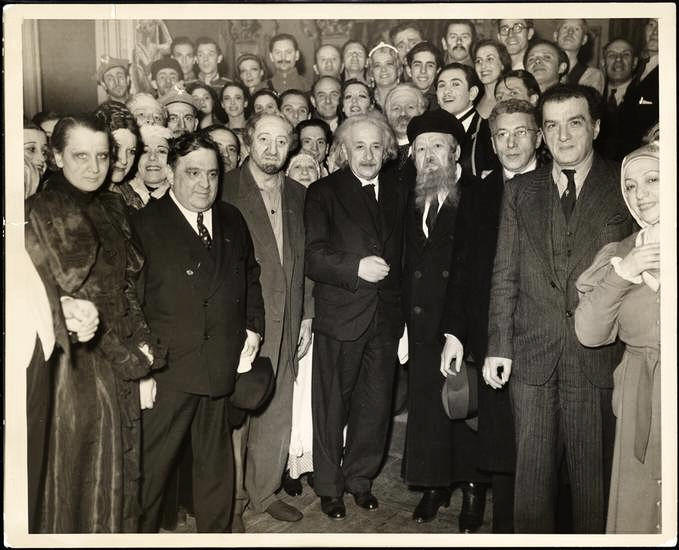
Albert
Einstein and Mayor LaGuardia |
|||||||||
|
Executive Staff: Edwin A. Relkin, General Manager; Leon Hoffman, Milton Weintraub, Managers; Lewis Kasten, Treasurer; Gertrude Wagner, Assistant Treasurer; Morris Crystal, Theatre Parties; Maurice Turet, English Press Representative; Motele Neuman, Secretary to Maurice Schwartz; Sigmund Gottlober, Program Publisher, Walter H. Morin (Advertising Guild, Inc.), Advertising. Technical Staff: Ben Katz, Stage Manager, Leonard Zurit, Assistant Stage Manager; Jacob Bakst, Master Carpenter; Harry Fox, Master Electrician; Sam Wolinsky, Master of Properties; Sam Lehrer, Master of Wardrobe. Wigs by Zauder Bros., Costumes by Meth & Gropper. |
|||||||||
|
1 -- From the play program for "The Brothers Ashkenazi", Yiddish Art Theatre, 1937. Courtesy of YIVO. |
|
|