|
So, here is the synopsis of Klabund's "The Chalk Circle". The name of the actor who portrayed the particular role is in parentheses): SYNOPSIS ACT ONE Tschang, a man of learning and refinement despite his humble trade of gardener, has had all his possessions taken away from him by the greedy and ruthless tax collector Ma (Julius Adler). He resorts to the peculiarly Chinese method of revenge by committing suicide in front of Ma's house, thereby charging him before the world with responsibility for his death. Tschang is survived by his wife (Miriam Elias), by his daughter Haitang (Bella Bellarina), a beautiful, accomplished and angelic girl of sixteen, and by his son Tschang-Ling (Mark Schweid), a spirited but easy-going student. Thus left penniless, the widow is forced to sell her daughter to Tong (Izidor Casher), the keeper of a tea house which is also a brothel. Haitang resigns herself to this life of degradation, but Tschang Ling protests. He becomes reconciled when part of the money Tong pays for his sister is turned over to him. Haitang enters one of the cages in which Tong keeps his girls. Presently she is visited by Pao (Lazar Freed), a young prince of the blood. The prince is fascinated by her beauty, wit and soulfulness, and she too falls in love with him. But their romance is nipped in the bud when Ma enters and offers to buy Haitang of [sic] Tong. Pao tries to outbid him, but has to withdraw when Ma offers a thousand taels for the girl. And so Haitang is forced to part with her "Prince Charming" and is carried off by the man who drove her father to his death.
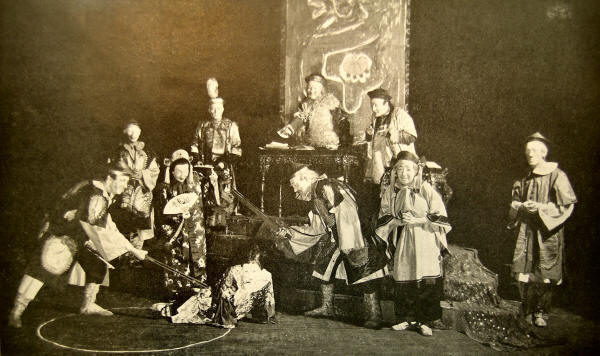
One year later, Haitang has presented the doting Ma with a child, which makes her all the more hateful to the jealous Yu-Pei. Ma's childless first wife (Anna Appel) ("wife of the first order," as she haughtily styles herself). Her paramour Tschao (Abraham Teitelbaum), the Clerk of Court, arrives in response to a summons of Ma. The lovers meet secretly in the garden, and Tschao intimates that since he cannot gratify his love for her, he may put and end to his life with some poison he had on him, then questions him regarding the law of inheritance. He tells her that when a man dies, his estate goes to his "wife of the first order" second wife if the latter has borne him a child. Yu-Pei hints that she has a plan for preventing Haitang from inheriting Ma's fortune. She then goes to announce Tschao to her husband. Ma comes into the garden, and when the two men are left alone, he informs Tschao that he has sent for him because he wants him to assist him, Ma, in getting a divorce from Yu-Pei, for which he will pay him handsomely. Tschao promises his aid and Ma returns to the house. Tschao at once informs Yu-Pei of Ma's intention to divorce her, and she resolves to carry out this very day the plan she previously hinted of Ma's garden. Haitang enters into a conversation with him, and the two soon recognize each other. He informs her he has been assigned by a secret society he belongs to kill Ma, and that this is why he has come. She defends Ma and pleas with her brother to spare him. As Ling is determined, she decides to consult the White Circle. With a piece of chalk she draws a white circle on the ground, then taking the knife with which Ling intended to kill her husband, she throws it, with the understanding that if it hits inside the circle, Ma is to be killed, otherwise he is to be spared. The blade hits exactly the line of the circumference, and she prevails upon her brother to go back to the leaders of the society and ask them to interpret this omen before carrying out the sentence on Ma. Before her brother leaves, she gives him her fur coat. He departs, and Yu-Pei, who was spying on the two, accuses Haitang of infidelity to Ma. The latter questions Haitang. She tells him the stranger was her brother, and Ma believes her because, as he says, he loves her. Tea is then served in the garden, and when they notice that sugar is missing, Yu-Pei offers to fetch it. She returns, but instead of sugar, she comes back with poison which she puts into Ma's tea. He unsuspectingly drinks it and soon drops dead. Yu-Pei at once begins to scream murder, and when police arrive accuses Haitang of having poisoned her husband. Haitang meekly submits to arrest, asking only that she be permitted to take her baby with her; but Yu-Pei brazenly asserts that the child is hers, and not Haitang's.
|
||||||||||||
|
The question of the child's maternity thus settled, the Court proceeds to take up the matter of the crime itself. Tschao testifies that Haitang's father committed suicide in front of Ma's house after the latter has seized his belongings in payment of overdue taxes, a fact which establishes a motive for the murder on Haitang's part.
Finally Yu-Pei
swears with studied ambiguity that the murder
was committed by the woman who is not the
child's mother. Haitang cries out in anguish
that Yu-Pei swore truly. This is taken as a
confession of guilt on her part, and the Court
sentences her to be beheaded. At this moment a
courier rushes in and hands the Chief Justice a
message. The Justice reads it with trembling,
for the message states that the old Emperor is
dead and has been succeeded by Prince Pao, and
that the new Emperor has ordered all executions
to be stayed and all judges and persons
condemned to die be brought to Peking so that
the Emperor may find out for himself whether
justice is being done throughout the land.
Tschu-Tschu's dismay is quite evident, whereupon
Tschang-Ling, who has been sitting among the
spectators, cries out to the judge: "What are
you afraid of, old fool? The new Emperor is no
better than the old. In his reign, too, the poor
will starve and drop dead in the streets."
Tschu-Tschu orders Ling to be held on a charge
of treason and to be taken to the Emperor, who
he hopes to please greatly with this arrest.
Scene 1 -- Haitang is marching on foot to Peking in a snowstorm. She is guarded by two soldiers. Presently they are overtaken by two other soldiers leading her brother. The soldiers decide to tie the two prisoners together so that it may be easier to guard them. As they trudge along, they are overtaken by three rickshaws, the first containing Tschu-Tschu, the second Tschao, and the third Yu-Pei (now married to Tschao) and Haitang's baby. Scene 2 -- From the conversation with the young Emperor with poet, we learn that he is still lovesick for the wonderful girl he once saw for a brief moment at Tong's tea house. Presently he goes to the Throne Room, where all the judges and condemned criminals of the whole country are assembled. He questions Tschang-Ling, admires his courage and soon sets him free. He then has Haitang brought before him. The two recognize each other. By an ingenious stratagem of King Solomon, he establishes that Haitang is the the mother of the child, and from this it is an easy matter for him to establish also her innocence and Yu-Pei's guilt of the murder of Ma. Yu-Pei confesses and implicates Tschao, who in turn appoints Tschao and Tschu-Tschu; she also forgives Yu-Pei for having tried to rob her of her child, but punishes her for having poisoned her husband by ordering her to go home and partake of the same poison. Thereupon all depart save Haitang. The Emperor requests her to tell him what happened to her the night Ma carried her off to his house. She relates that Ma placed her in a room whose door opened upon a garden. She pleaded with him, and he let her alone that night, and because it was so hot she slept with the door open. When she fell asleep she had a wonderful dream. She dreamt that a handsome young man stole into the room from the garden, came over to her couch, lay down by her side and embraced her as a man embraces his bride. The Emperor is surprised that she should remember a dream so vividly, and Haitang answers that this was because he was the man she saw that night in her dream. Thereupon he tells her that it was no dream, but an actual occurrence, for he followed her that night and stole into the room where she was sleeping, and overpowered by her charms yielded to his passion. He begs her to forgive him, and she agrees to do so provided he will acknowledge her child as his own. He replies that this very day he will proclaim her his wife before all the people.
|
||||||||||||
|
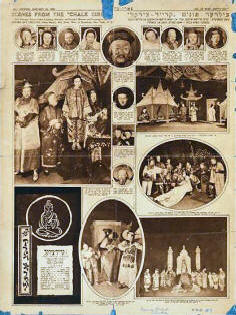
1 -- From Wikipedia, "The Circle of Chalk". 2 -- Maximilian Hurwitz. Playbill for the Yiddish Art Theatre's production of "The Chalk Circle", Courtesy of YIVO. |
|
|