|
THE GOLDEN CHAIN1,
by I.L. Peretz (Yiddish: Di goldene keyt) |
|
|
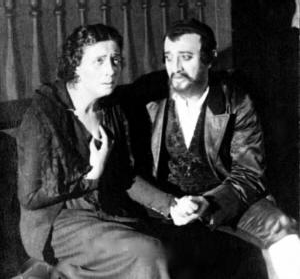
"The Golden Chain" (1907) by I.L. Peretz is considered to be the crest of his dramatic writing. The play portrays three generations of a Hasidic court that are on the verge of inhalation. The play opens with the last generation, Rabbi Moishe, who is desperately trying to invoke his ancestors to come to his rescue and help him lead the congregation, but he turns out to be a weak leader and he is incapable of saving his court. As this happens in flashback scenes, the play takes us back to his grandfather's home, Rabbi Shlomo and his father, Rabbi Pinchas. We are now at the eve of the Sabbath in the home of Rabbi Shlomo. The people are waiting for the Rabbi to come out of his room and make Havdalah – the ceremony that releases one from the Sabbath and enables him to return to his daily routine. Rabbi Shlomo refuses to make Havdalah, because he wants to keep them in the spiritual level of the Sabbath, an eternal Sabbath. The meaning of his decision is a life of pure spiritual, religious being with no hierarchy, judgment (God does not judge on the Sabbath), and by thus saving his congregation. Rabbi Pinchas, Rabbi Shlomo's son, revolts against this decision and makes the Havdalah on his own. He does so not meaning to protect the people but to force them to be judged and condemned for their sins. |
|
|
|