|
THE SHEPHERD KING1,
by Leizer Treister
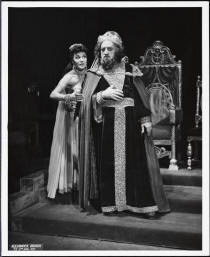
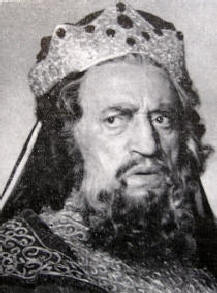
The King, compelled by Samuel (Jacob Fisher), reluctantly continued to wage ruthless wars. He loathed to shed the blood of old men, women and children, and he suffered in silence. He began to doubt that Samuel's commands were truly those of the Lord because the Almighty is a God of Compassion. When Samuel ordered the King to annihilate the Amelekites, he disobeyed. He carried off their herds, took the women and children into captivity and brought King Agag into the palace as hostage against further molestation. Samuel, in a fury, slayed King Agag in the kingly palace. The sight of this bloodshed unnerved the peaceful Saul. Samuel, gravely ill, had inserted a decree in his will against the King, to be read to the people after his death by the High Priest, Ahimelech (Menachem Rubin) to the effect that King Saul be dethroned and his heirs never to wear the crown. When the King learned of this decree, he cast off his armor, determined not to war against the Philistines.
The forsaken Queen, Ahinoam, greatly perturbed, sends for her children in the middle of the night to learn from them why the King had refused to wage war on the enemy! The King, learning the truth of the prophet's decree from the High Priest, Ahimelech, orders him confined in the palace, and rushes off to his star-gazer, the Edomite, Zelek, to read to him what the stars foretell about his destiny. During his absence, the lovers Ritzpah and Abner are conspiring against the King. Upon the King's return, he confides to his mother, Naomi (Rosetta Bialis), that the star-gazer foretold his downfall. Since he had always yearned to return to his pastures as a shepherd, he feels now that it is time to abdicate. He thereupon asks Ritzpah to come with him, but she considers him insane, and joyously believes that the crown is now within Abner's reach. The now-repentant King suddenly makes his way to his estranged Queen, and appeals to her to return with him to relive the happy days of their youth as shepherds; his children are bewildered at his demands. The Queen, anxious to save the crown, urges their son, Jonathan, to hasten to Samuel to seek anointment. Jonathan believes that his father's distress stems from the sense of shame because there is no one in Israel to accept the taunting challenge of the giant, Goliath, and seeks his father's permission to fight the Giant. The King refuses to risk his son's life, but sends him to the Prophet Samuel to be anointed as King. Upon reaching the prophet's hut, Jonathan learns of Samuel's death! Jonathan returns to the palace to report to his father what the High Priest read in the will of the prophet, Samuel: that Ritzpah and Abner are plotting to get the crown, that the Palace is a house of sin, and that a young shepherd, David (Edmund Zayenda), of Bethlehem, will inherit the crown! The King, infuriated at the news, orders his son to leave, and tells his mother, Naomi, that he does not believe that David would inherit his crown, that should David be victorious over the Philistine giant, Goliath, it would be a sign that the Almighty is with the King, and not with the deceased prophet. The miracle occurs. David destroys the Philistine. Accompanied by jubilant shepherds, David brings the head of Goliath to the palace. The King elevates David to be his chief commander in Abner's place. He also offers him his younger daughter, Michal, in marriage. The King then asks David to sing and play the harp. When David chants one of his favorite shepherd psalms, King Saul is struck by the divine spirit of the chant, but in a fit of jealousy and apprehension for his crown, terminates the celebration.
The King is convinced that God is with him because of David's victory. Fearful of God, and to appease His wrath against misbelievers, such as the stargazers and sorcerers, he determines to have them annihilated. The Queen, unhappy by the King's decision to give his youngest daughter, Michal as wife to David, appears before the King to plead for the elder daughter, Mayrav who, according to tradition, is entitled to be married off first. Loving both daughters, the King regrets that he has erred, and decides to give his younger daughter, Michal, to the commander, Adriel (Jacob Zanger), head of the tribe of Judea. When Michael, greatly in love with David, learns of her father's decision, she decides to leave the palace and bids a final goodbye to her brother, Jonathan. She hears the singing of the people as David returns from Bethlehem, where he had visited his father and brothers. She begs Jonathan not to reveal her decision to David and hurries away. David and Jonathan greet each other with joy. David looks forward with eager anticipation to the wedding with Michal, unaware of her flight. The King, fearing David's great popularity with the people, is shaken by jealousy, and cannot find repose day or night. Ritzpah incites the King against David: "He is beloved by the people and you and your crown prince are hated. David will soon wrest the crown from you. Destroy him together with the High Priest. They are plotting your downfall!" She persuades him to reappoint Abner as the chief commander of Israel's hosts and to banish David as a traitor! At a general assembly in his throne room, King Saul, in great agitation, throws his spear at David, but misses. He then orders David banished to the wilderness for life, and dooms Ahimelech with all his priests and their families. The people, outraged, storm the palace and kill Doeg (Leon Shechter), the head of the King's herdsmen. Abner flees and joins the Philistines on Mount Gilboa to wage war against the King in order to win his crown! King Saul, in despair, goes to the only surviving sorceress of Ein Dor (Rose Shoshana), who conjures up the spirit of Samuel, who foretells King Saul's doom and also affirms that all his commands came from the Lord, and that the anointment of David was also God's will. The King, aghast, cries out: "Why did you impose kingship upon me? I was happy as a shepherd! It was you who ruled the throne, not I!" Despite his awareness of his approaching end, the King hastens to Mount Gilboa to oppose the Philistines. There he hears the approaching enemy and determines to die by his own hand, rather than be taken prisoner. David routes the Philistines and captures the traitorous Abner and Ritzpah. In the battle, Jonathan and his two younger brothers are killed. In awe, David stands before the body of King Saul. Bitterly he execrates Mount Gilboa, where the heroes fell. Deeply affected he eulogizes the King and his son, Jonathan and, with humility, bows to the Lord's will that he be King of Israel. |
||||||||
|
Executives for the Yiddish Art Theatre Association, Inc.: Business Staff: Herman Yablokoff, General Manager; Harry B. Kaufman and Wolf Mercur, Managers; Max Kreshover, Benefit Manager; Ann Woll, English Press Representative; Rose Goldstein and Larry Rothman, Treasurers; Morris Honig, Attorney. Stage Staff: Sholom Secunda, Musical Director; Saul Raskin, Settings & Costumes; Mabel A. Beull, Scenic Artist; Morris Strassberg, Technical Stage Director; Marvin Schwartz [Maurice Schwartz's adopted son], Assistant Stage Manager; Gaiptman Studios, Costumes; Max Friedlander, Librarian. Technical Staff: Peter Kanter, Master Carpenter; George M. Dignam, Master Electrician; Bernie Stahl, Master of Properties; Nathan Gaiptman, Master of Wardrobe; Ira Senz, Wigs; Rene Humbert, Superintendent.
Fowler Scenic
Studio, Draperies; Encore Studio, Furniture and
Props. |
||||||||
|
|
||||||||
|
1 -- From the playbill to "The Shepherd King", 1955. Courtesy of the New York Public Library, Billy Rose Theatre Collection. |
|
|