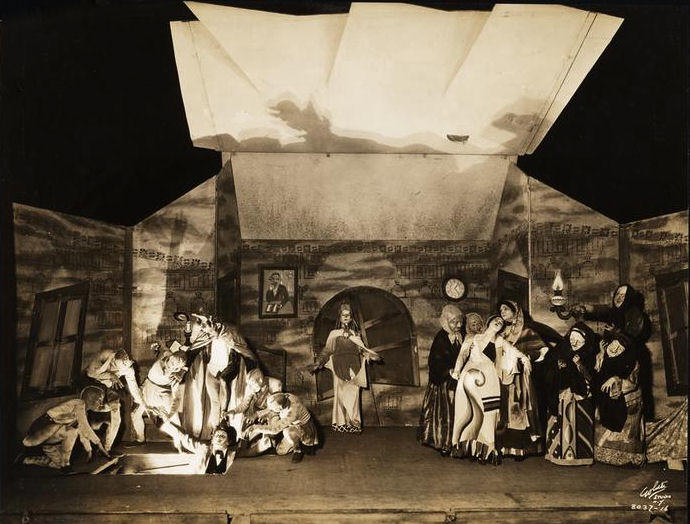
|
THE TENTH COMMANDMENT1,
by Avraham Goldfaden
Introductory note: " 2
So, here then is the synopsis of Goldfaden's "The Tenth Commandment". The name of the actor or actress who portrayed a particular role is indicated in parentheses: SYNOPSIS PROLOGUE
Ahitophel,
accompanied by devils, appears and boasts of his
powers in leading men astray. The Yezer Tov,
accompanied by angels, appears and tells of his
efforts to make men walk in the paths of
righteousness. Ahitophel mocks him and declares
he is about to corrupt Peretz, a wealthy and
pious Hassid of Nemirov, by causing him to fall
in love with another man's wife. The Yezer Tov
dares him to do it and vows that he will
frustrate the evil designs of the Tempter. ACT ONE Sabbath Eve. Peretz returns home from the synagogue accompanied by a stranger whom, in accordance with the Jewish custom, he has invited to be his guest for the Sabbath, and who, be it added, is none other than the Yezer Tov in disguise. The two are welcomed by Fruma, Peretz's good-looking and kindly but forbiddingly pious wife, whose kisses go to the prayer book rather than her husband. They sit down for the Sabbath meal, and the rich dishes cause the guest to fall asleep in his chair at the very moment when the house is surrounded by, Ahitophel and his minors. Fruma retires to her chamber; the guest is still sleeping in his seat, and Peretz, thus left alone, contrasts his dreary, home life with the gay and luxurious one of Ludvig, his business associate in Berlin, and the all too pious Fruma with the ravishing and voluptuous Mathilda, Ludwig's wife, with whom Peretz has been smitten ever since his recent visit to Berlin. He struggles against temptation, but in vain, While the Yezer Tov is nodding, Ahitophel carries off Peretz, knowing that he will there by gain a twenty-four-hour start on the Yezer Tov, as all pursuit is forbidden in the Sabbath. Peretz, is brought to a haunted inn by the roadside, where, amid scenes, reminiscent of a Walpur gis Night, Ahitophel reveals his true identity to Peretz, promises to give him the fair Mathilda and to make Fruma believe thather husband has been drowned. In return for this Peretz is made to swear eternal allegiance to him. Thereupon he and Peretz speed to Berlin and, in the guise of Tyrolese singers, arrive at Ludwig's palatial home at the very moment when a ball is in progress there. They find the host melancholy and distracted, for ever since his recent visit to Nemirov, Ludwig has been madly in love with Fruma, whose 'piety and modesty he found infinitely more alluring than the tempestuous affection of the voluptuous Mathilda, Ahitophel, astonishes Ludwig by telling him the thoughts which Ludwig, has been harboring in secret, and promises to give him Fruma in return for his soul, a bargain Ludwig readily agrees to. Thereupon Ahitophel cause the next-door house to catch on fire and leads Mathilda to believe that Ludwig has perished in the flames.
The grief-crazed Mathilda and her maid Clementine are walking in a cemetery, where Mathilda is looking for her husband's grave, though the latter is supposed to have perished in the fire. Ahitophel, disguised as witch godmother, lures Mathilda into a hut, tells her of Ludwig's infidelity to her, and finally inveigles her into marrying Peretz. He likewise bamboozles Fruma, who has gone to the Holy Land to seek solace for her grief at the graves of Jewish saints, into a marriage with Ludwig. However, neither marriage is destined to be consummated. All of Peretz's ludicrous attempts to acquire Western polish fail to win him Mathilda's love; and though Ludwig dons a Hassid's garb and tries to carry out faithfully orthodoxy's innumerable observances. Fruma is too busy with good works and pious parasites to give him the kind of attention he hungers for. In the end, Peretz, infuriated by Mathilda's indifference, and constantly goaded by the taunts and jeers of his servant Friedel (who is none other than the Yezer Tov in disguise), kills Mathilda, whereupon he himself vanishes amid smoke and flames. And Ludwig, finding the immovably pious Fruma deaf to all his love pleas, decides to go back to Mathilda and vows that if he ever leaves her again, may the devil take him. At that very moment Ahitophel appears and carries him off to his Plutonic realm. A few moments later Fruma, who has never ceased to mourn Peretz, drops dead.
In hell, Ahitophel's domain. Devils haul in the souls of departed sinners in wheelbarrows. The minion who tends to hell's vast furnace, thanks Ahitophel for the latest haul of sinners, as business was getting rather slack of late. Various souls are held before Ahitophel for judgment, and the sentences he passes afford the author an opportunity for many a sly dig at the evils of our social system. Finally Peretz and Ludwig are brought in and learn with dismay that each was married to the other's wife for three months. Both regret their folly, both declare that neither has had conjugal relations with the other's wife, and both express the desire to return to their original spouses. Ahitophel realizes that he has been worsted by Yezer Tov, for though Peretz and Ludwig were ready to sin, their wives prevented them from doing so. In disgust he packs them off to Paradise, where their wives are. Arrived there, a reconciliation is soon brought about between Peretz and Fruma, and between Ludwig and Mathilda. By the Yezer Tov's decree the two couples are sent back to earth to spend the rest of their allotted days there. |
|
|
1 -- From the play program for "The
Tenth Commandment", Yiddish Art Theatre,
1926-1927 season. Courtesy of YIVO. |
|
|