|
YOSHE KALB,
by I.J. Singer
I. J. Singer's "Yoshe Kalb" was performed a number of times by Maurice Schwartz's Yiddish Art Theatre, bot domestically and abroad. It first opened on 9 September 1932 at the Folks Theatre at 189 2nd Avenue (and 12th Street.), then again in 1939. The cast for the 1932 production included a very large cast, including: Maurice Schwartz, Joseph Schwartzberg Saul Fruchter, Eli Mintz, M. Schtrommer, Solomon Krause, Michael Rosenberg, Michael Gibson, Anatole Winogradoff, Wolf Goldfaden, Morris Silberkasten, Mark Jury, S. Pincus, S. Lioff, Zelda Ludwig, Ida Garber, A. Belov,L. Bergweiss, A. Margolies, Albert Stone, Anna Appel, Sonya Gursky, Liza Varon, Judith Abarbanel, Noach Nachbush, K. Urki, Rosetta Bialis, Lazar Freed, S. Merkur, Leah Naomi, Charlotte Goldstein, R. Schweid, A. Nemson, M. Misich, F. Sherr, Morris Belavsky, Michael Rosen, N. Steinfeld, Michael Gibson, Solomon Krause, L. Eisenberg, Pincus Sherman, M. Swerdloff, Uri Kagar, Rose Weiss, S. Berl, Izidore Casher, Helen Zelinska, Leah Kauffman, S. Lazar, R. Rose, Bergman, Gustav Schacht, L. Weisberg, Zelda Gould, Hyman Buchwald, Isaac Rothblum, H. Franko, Morris Strassberg.
"Yoshe Kalb" was
produced in two parts and twenty-six scenes.
Stage version and direction by Maurice Schwartz.
Dances by Lillien Shapero. Edwin A. Relkin &
Sigmund Weintraub, Personal Representatives for
Maurice Schwartz. Director: Maurice Schwartz;
Stage Manager: Ben Zion Katz; Librarian: Joseph
Schwartzberg; Musical Director: Leo Kutzen;
Master of Wardrobe: Ben Spitzer; Managers: Leon
Hoffman and Milton Weintraub; House Manager
Morris Lyons; Treasurer: Gertrude R. Wagner;
English Publicity: Joseph Brainin. Technical
Staff: Master Carpenter: Irving Levy; Master
Electrician: Morris Shapiro; Master of Props:
Sam Wolinsky; Scenic Designer: Alex Chertov.
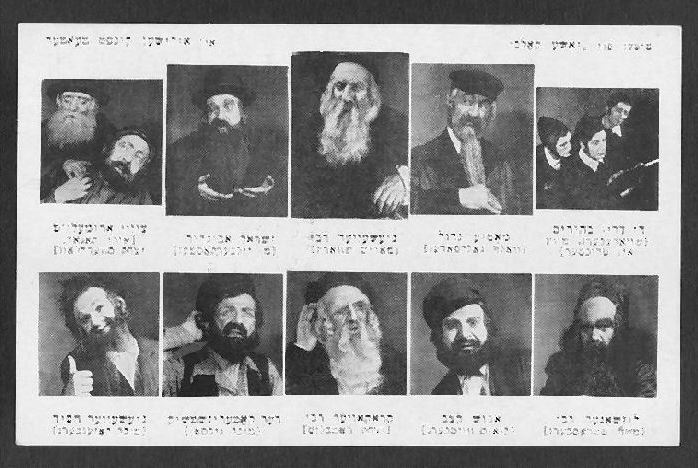
CAST OF CHARACTERS FROM "YOSHE KALB" Top row, left to right: Two poor men (Uri Kaner and Isaac Swerdloff), Israel Avigdor (Morris Silberkasten), Nyeveshe Rabbi (Maurice Schwartz), Motye Godol (Wolf Goldfaden), and the three Young Men (Joseph Schwartzberg, Eli Mintz, and Saul Fruchter). Bottom row, left to right: The Nyeveshe Chasid (Michael Rosenberg), The Katerinchik? (Michael Gibson), The Krakow Rabbi (Isaac Rothblum), ...(Louis Weisberg), and the Lizshaner Rabbi (Morris Strassberg.)
Music by Leo Kutzen, settings by Alexander Chertov, and dances by Lillian Shapiro Adapted by Maurice Schwartz from the Novel by I. J. Singer. From the New York Times, 3 October 1932:
“The story it
unfolds is of a powerful Chasidic rabbi, whose
concerns are very much of this world. Having
already buried three wives, in his seventieth
year he sets eyes on a spirited young girl and
determines to make her No. 4. To satisfy the
proprieties, however, he must first marry off
his young daughter, a child of 15, and he
arranges a match between her and a boy who is so
deeply wrapped up in a Kabala that the marriage
cruelly wounds him. He in turn hurts his wife by
his coldness, and she is too unknowing to
overcome it. The girl whom the aged rabbi has
married, however, is a spitfire: she won’t have
the old man, but she falls in love with his
ascetic son-in-law and makes him return her
passion. When she dies in childbirth, the youth
turns to a life of wandering to expiate his sin."
SYNOPSIS Introductory Note The great mine of Chassidic lore and legend, which has already yielded such dramatic masterpieces as "The Dybbuk" of S. An-sky and "The Saint's Journey" of Harry Sackler, yields in the present play another gem of "the purest ray serene." "Yoshe Kalb" is the story of a lovable young mystic's fall from grace, of his sin and suffering, of his terrible meekness and resignation, of his silence (by way of penance) under false accusations, and the complications, including that of dual personality, which this gives rise to. All these and other strands are skillfully woven together into a gorgeous tapestry, hung against a background of Chassidic life with its turbulence, coarseness, and superstition relieved by felicitous touches of humor.2 The author of "Yoshe Kalb," who with this work becomes one of the most promising figures of Yiddish literature, is I. J. Singer, Austrian correspondent of the Jewish Daily Forward, where it originally appeared as a novel. The dramatic version was made by Maurice Schwartz, Director of the Yiddish Art Theatre. The reader should bear in mind the difference between an ordinary rabbi and a Chassidic Rabbi. Whereas the former is merely the pastor of a single community or congregation, the latter, by virtue of the superior wisdom, saintliness, and miraculous powers attributed to him, is the spiritual ruler of a vast number of adherents in many cities and towns, to whom his word is law. His followers pay him princely honors and tribute, and he lives in semi-regal state. His household resembles a court, and like it is full of intrigue. His office is hereditary. There are many such rabbinical dynasties in Poland.
Reb Melech (Maurice Schwartz), the coarse, greedy, and domineering Chassidic Rabbi of Nyesheve, in Austrian Poland, is desirous of marrying again, although he is 68 years old and thrice a widower. The object of his desire is the young and beautiful Malkale (Charlotte Goldstein), niece and ward of his follower, Mechele Hivnever (Noach Nachbush). But before he can attain his end, he must marry off his youngest daughter, Serele (Judith Abarbanel)--beautiful, docile, passive and only fifteen. The bridegroom he chooses for her is the young, learned, pious, dreamy, and mystically-inclined Nachumtche (Lazar Freed), only son of the more sympathetic and refined Chassidic Rabbi of Rachmanivke (Anatole Winagradoff), in Russian Poland. He persuades and bullies the boy's father until the latter consents to the match.
The marriage is celebrated in regal style, as befits the union of two such illustrious houses. But Nachumtche is more interested in his mystical studies than in his bride and shows it by neglecting her on their wedding night. Having married off his youngest daughter, Reb Melech proceeds with the preparations for his own marriage to Malkele, who is coaxed and cajoled into the match by her guardians. But his triumph is short-lived. Malkele is as spirited as a race horse; in her veins there courses the fire of passion; and on their wedding night she humbles his pride by making him feel what he really is--a very old man. Worse yet, she soon falls in love with Nachumtche. Unlike Serele, she knows how to awaken his love, and before long he, the ascetic Cabalist, succumbs to her blandishments and commits the mortal sin of adultery. Nine months later she dies in childbirth. Thereupon, although no one suspects his guilt, Nachumtche is so overcome by remorse that he flees from his home and becomes a wanderer like Cain.
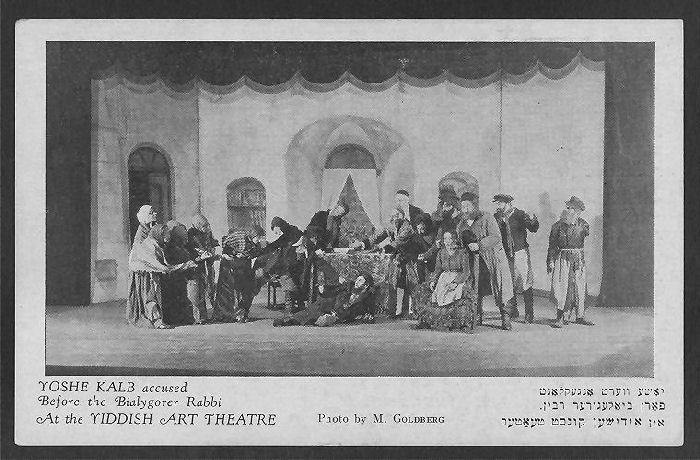
For many years Nachumtche, now calling himself Yoshe, wanders all over the land undergoing every hardship and submitting to every indignity at the hands of his fellow vagabonds who, because of his meekness and extreme piety, nickname him "Yoshe Kalb" (i. e. Yoshe the Simpleton). Finally he arrives in the town of Byalegure, where he becomes assistant to Konoh the Sexton (Izadore Casher), who takes him into his house as a prospective husband for his motherless, lewd, and moronic daughter Zivya (Helen Zelinska). A plague breaks out, and the townspeople attribute it to the prevalence of sin and vice in their midst. A committee sets out in search of sinners, and soon it is discovered that the unmarried Zivva is big with child. She is haled before the rabbinical court, but her father defends her by saying that it is Yoshe Kalb who has seduced the simple-minded girl.
"YOSHE KALB ACCUSED BEFORE THE BIALYGORER RABBI"
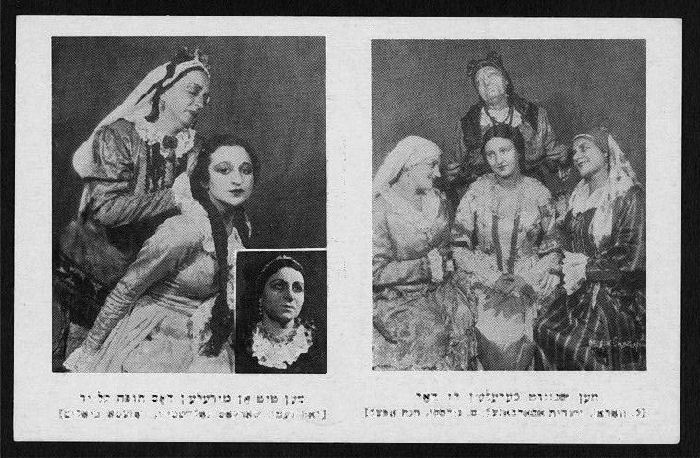
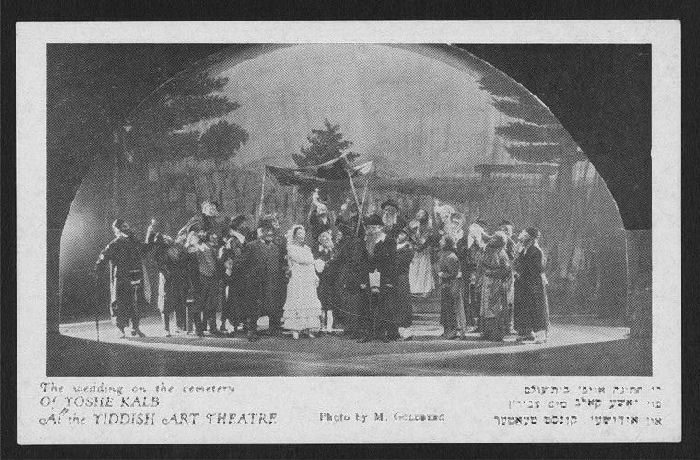
"THE WEDDING ON THE
CEMETERY OF YOSHE KALB" Shortly afterwards he returns to Nyesheve, where no one recognizes him owing to his fifteen years' absence. He soon convinces the aged Reb Melech and Serele that he is the long missing Nachumtche. Reb Melech rejoices over the return of his son-in-law and declares his intention to make him his heir and successor, his own sons having proven unworthy. But word of Yoshe Kalb's pressence in Nyesheve reaches Shachna (Gustave Schacht), a member of the rabbinical court of Byalegure. He hurries to Nyesheve and publicly denounces Nachumtche as an imposter and bigamist. Reb Melech staunchly defends his son-in-law and vows dire vengeance on Shachna, but the latter holds his ground. A great controversy ensues, which shakes Jewry from center to circumference. Finally, a court of seven eminent rabbis--a veritable synhedrin --is convoked.
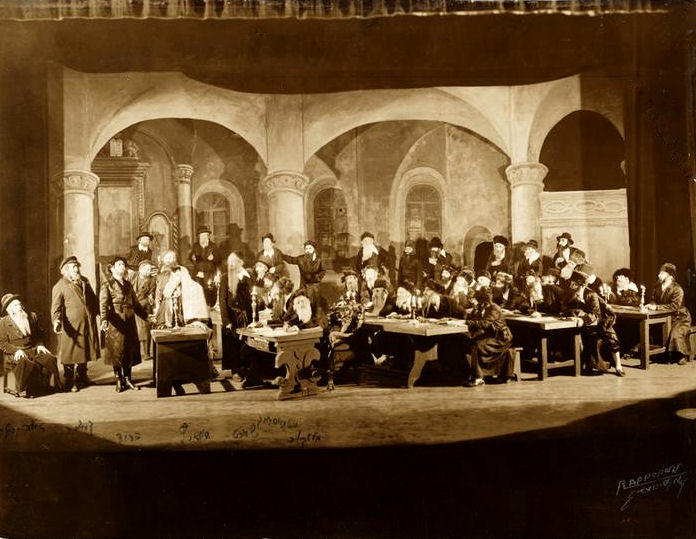
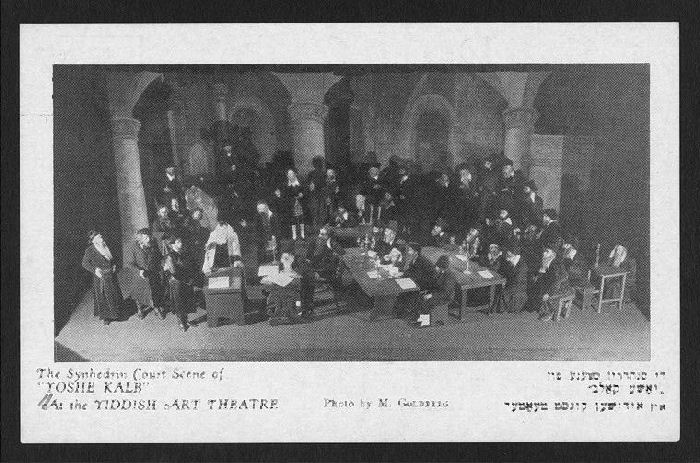
"THE SYNHEDRIN COURT
SCENE OF 'YOSHE KALB'" The trial scene that follows is one of the most effective in the whole range of dramatic literature. As both sides offer equally convincing testimony, and as Nachumtche refuses to say who he really is, the court is non-plussed. Finally the rabbi of Lizhan (Morris Strassberg), a member of the great court, takes over the questioning; and after learning from both Serele and Zivya that the defendant was in the habit of hiding from them a good deal of the time and of frequenting cemeteries at night, he declares that both sides have told the truth, and pronounces the defendant a gilgul--a lost and wandering soul, drifting aimlessly to and fro in the world, and bringing ruin and misfortune wherever he appears. The shock of this pronouncement kills the aged Reb Melech, and in the general excitement that follows, Nachumtche flees and becomes once more a wanderer like Cain. |
|||
|
1 -- From the play program and souvenir book for "Yoshe Kalb", 1932. Courtesy of the New York Public Libary. 2 -- Synopsis [prepared by Maximilian Hurwitz. Courtesy of YIVO. |
|
|