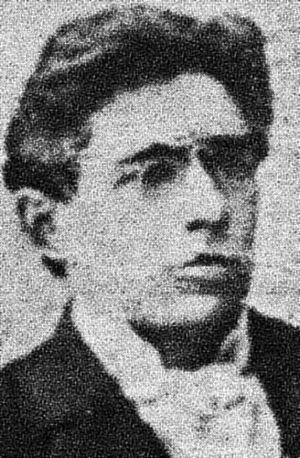
|
where
he founded together with Leibush Gold, M. Nakhamkus,
a certain Schwartz and Kurazh an actors' union,
which however soon fell apart, also due to what was
taken in by the patrons of the troupes.
In 1900
A. returned to Russia and joined the Odessa troupe
of Spivakovski and Fiszon. His arrival was an
important event for Yiddish theatre in Russia,
because he brought with him the newest repertoire
from America, and also a modern place for staged
plays.
In 1901
he directed in Kiev in Goldfaden's "The Sacrifice of
Isaac," in such a rich, theatrical manner, that in
this one instance he elevated the fallen prestige of
this Yiddish theatre.
During
that time A. also led a thorough reform regarding
the fees of the Yiddish theatre. Until then there
existed in Russia the so-called markn- (border)
troupes, a system that gave the agent of the troupe
an easy opportunity to exploit the actors. A. was
the first to engage a troupe on a particular hire.
In 1903
A. guest-starred for a year's time with Moshe Schorr
in the Galician province, where he directed the
newly brought repertoire ("Isha ra'ah," "Ezra, the
Eternal Jew," "Kol Nidre," "Kurkh's Treasures"), and
he went from there again out to Russia. In 1905 A.
partnered with Spivakovski in the direction of a
Yiddish troupe in Odessa, and there was a contract
signed between them and Sholem Aleichem, that their
theatre should become transformed into a "Yiddish
literary art theatre," which would stage the
dramatic works of Sholem Aleichem and plays from
other authors over whom Sholem Aleichem had control
and determined that they were worthy to perform. The
plan was not achieved because the competitors had
... the power, that the newly planned theatre was
considered a revolutionary trend, and the government
profoundly stifled the enterprise.
In
1905, together with Vaysfeld at the Nowy Theatre in
Warsaw, he then played for the first time with
Meerson in Schiller's "Robbers" in Yiddish.
In 1907
A. had a great theatrical success with his staging
of Goldfaden's "Lakhmud" in Kiev, and in 1909 he
transformed in Yekaterinoslav his revived staging of
"Shulamis" in an immense spectacle, directing on the
stage, in the scene of eulh-degel-zayn, until
a hundred sympathies(?), raising in that city the
prestige of Yiddish theatre, which had fallen
greatly there due to the management of previous
Yiddish theatre directors.
In
terms of solidness and principles, the company of
"Sam Adler from America" was the reliable and fartroyungsvertste.
There had not been any city in the Jewish Pale of
Settlement in Russia, wherein it did not reach his
permanent well-organized operetta-and-drama troupe.
It also was for a long time the only one in Russia
that had access to plays mkhuts ltkhum -- in
Petersburg and Kiev-- where A., from all strata of
the local Jewish population was very warmly
received.
Actors
considered it an honor to be engaged in the troupe
of Sam Adler, and for the young actors the acting by
the troupe was at a high level. A. was the first to
arouse to the Yiddish stage the intelligent forces,
and they were encouraged about Yiddish theatre.
Among his students one finds: Jacob Ben-Ami, Lazar
Freed, Esther Neroslavska, Samuel Goldinburg, Wolf
Zylbercweig, Greenspan, Avraham Teitelbaum et al.
A.
always gave [his] attention, that the member of his
troupe should perform in each city, tactfully and
responsibly and keep up their social standing, but
even more straightforward was his stage discipline.
The rehearsals and the productions were conducted
most forcefully. The following were not allowed: not
coming prepared, not being punctual, dirty language,
vulgarity, and innuendos had always been put aside.
The language and the acting -- even from the cheap
plays -- had to be clean.
Sh.
also put aside the business side of Yiddish theatre
on festere isudut, leading tours according to
a previously determined plan, and even at the
government office [gained] that respect, that they
were not confused when he changed the company of his
troupe from "German troupe" to "Yiddish-German
troupe."
By
himself the comic of the troupe, A. never allowed
cheap exaggerations and had not sooner played a role
as ibergeshpilt.
A. had
been known to write a little Yiddish, or Yiddish
with Latin characters, but A. possessed a native
intelligence, always wanting things nice and
beautiful on the stage.
In the
last pre-war years, A. lost a lot of money in his
undertakings, and his undertaking spirit becoming
weak. He no longer appeared to organize troupes in
the same way as before. His most important actions
were to travel across the world; A. used to move
around across small cities with small troupes, which
however were not in his heart, and by playing with
these troupes A. began to lose his former
popularity.
When A.
returned to America, through the influence of
Ben-Ami, he joined Schnitzer's Garden Theatre, where
he worked with small, ascending roles.
The
Yiddish [Hebrew] Actors' Union helped him
materially, but due to his inherently quiet
character, he withdrew into the shadows, until 1922
when he returned to Europe, playing in Kovno, where
he suddenly became hoarse performing in December
1922 in Lodz in Kobrin's "The Power of the Dollar"
("Karl Marx," or, "The Enemies"), and he had to,
according to the information from the doctors,
immediately traveled to Vienna to be operated on.
Here he
still had the opportunity to participate in a small
role in the film, "Yizkor," played with Schwartz's
troupe, and also had several small roles in film
with the same film society.
A.
lived in Vienna, single, in a small room on a
faraway street, somewhere behind "Prater Shtern." Not
being able to speak, he used to spend the entire day
sitting in a coffee house stiff and cold as a
statue, often confused and burnt out.
The
financial support that he had received from his
students in America were swallowed up in caves [heyl-mitlen].
In the summer of 1925, when his health condition was
getting worse, and he simply hungered, he finally
allowed a public discussion in the press about his
condition. However the discussion brought only petty
results.
For the
death throes he received a shipyard to America,
wherein he had, however, not wanted to travel to as
an invalid, and so on 26 November 1925 he passed
away in Vienna. The Viennese Jewish cultural
community had for that reason given free of charge a
burial plot and linens.
M. E. from Moshe Schorr and Lazar Freed.
-
B.
Gorin -- "History of Yiddish Theatre," Vol. II,
pp. 60, 142, 192.
-
Dos
"sholem aleichems bukh," New York, 1926, p. 64.
-
Avraham Teitelbaum -- Teatralishkeyt bay
goldfadenen, "Goldfaden-bukh," New York, 1926,
pp. 17-8.
-
Avraham Teitelbaum --"Teatralia," Warsaw, 1929,
pp. 24-33.
-
Michael Weichert -- "Theatre and Drama," Vilna,
1926, Vol. I, p. 59.
-
Noach Prilutski -- "Yiddish Theatre," Bialystok,
1921, Vol. I, p. 39.
-
Sh.
Y. Dorfszon -- Necrology, "Morning Journal," New
York, 25 Dec. 1925.
-
Sh.
Y. Dorfszon -- In khl'she tchrichim, "Moment,"
Warsaw, 8 Dec. 1925.
-
Avraham Teitelbaum -- Der suf fun a yidishen
teater-direktor, "tog," New York, 15 Jan. 1926.
-
Dos
teater oyf krulevska -- "Theatre Times," Warsaw,
5, 1928.
-
E.
Tenenholtz -- The Yiddish Theatre in Siberia,
"Di varhayt," 7 January 1917.
-
M.
Miodovnik -- My Theatre Memories," "Shtern,"
Minsk, 4, 1926, p. 36.
|