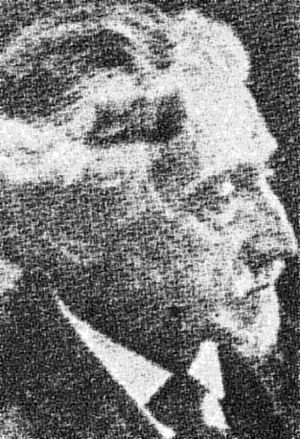
|
little
later on he learned Hebrew. At that time there was
also made A.'s first acquaintance with his neighbor
and friend Chaim Zhitlowsky. At age seventeen he was
well-versed in Hebrew literature, and under its
effect became an epicurus and began to energetically
learn the Russian language, from which he had until
then not had any concept. He introduced himself to
radical Russian literature, and faithfully its new
ideals, and A. learned a trade -- at first to be a
blacksmith, then a bookbinder.
In the
beginning of 1881 he traveled to Liozna, where he
went to study, but most of the time he took up
spreading the epicurist socialistic ideas among the
youths there. Due to the persecutions of a rabbi, he
was forced to go to Dvinsk, and there he continued
with his self-education, and also began to write a
day book in Yiddish. A.'s first serious literary
attempt was his story "Di geshikhte fun a familye."
Soon
through the first story he received attention and
fell into the atmosphere of the Russian-Yiddish
literature. Not finding more for themselves the
associated resonance on the Jewish streets, A.
descended the depths of Russian folk life, The
impact of the "narodnik" literature drove him
to "go into the people."
In 1892
he went away to Western Europe to familiarize
himself with the life of the worker there, and he
spent a short time in Berlin, then in Bern, then in
Paris, where he worked as a bookbinder, and from
1894 until 1900 he became the private secretary of
the Russian Socialist leader P. Lavrov.
Through
the resonance of the new movements in Russia, and
thanks to the influence of the Jewish immigrant
board in Bern, which A. had visited part-time due to
Zhitlowsky, A. became a little closer to the Jewish
spheres of interest, and even turned in his Russian
stories to Jewish themes. He also began to publish
in print in Yiddish, and composed "Di shvueh (The
Oath)," which then became the hymn of the "Bund."
During
that time A. also composed an application of his
Yiddish-Russian socialistic colleagues -- his comedy
"In a konspirativer dirh." The comedy generally was
written within one night, in Russian, and it was
staged through the Russian socialistic members in
the yearly ball in Bern. The main roles were
performed by Chaim Zhitlowsky (agent of the okhranke)
and Victor Chernov (performing from the Zhanarmsker
Oprave).
Soon
thereafter A. composed in Yiddish his comedy "Foter
un zun (Father and Son)," which for the first time
was published in print [according to a personal
declaration by An-ski to Z. Zylbercweig] in an
illegl Bundist edition in Switzerland. Then it was
published in the publishing house of "Di velt." [S.
Anski "Der foter un zuhn," Vilna, 1906, 24 pp.,
16°].
After
the manifest of 1905, A. returned to Russia, where
he began to take a active role in the S. R.
movement, and he also began to take up with Yiddish
folklore, published in the Russian-Yiddish edition a
series of articles about the Yiddish folk
establishment, participating in the Yiddish
historical-ethnographic society in Peterburg,
directing the first scientific expedition in the
name of Baron Horace Ginzburg to collect the works
of Yiddish folklore, and together with Joel Engel
and his nephew Yudovin, visited over sixty-six
locations in Volhynia and Podolia, where he
collected all together a rich collection of old and
rare museum objects and writings, folk stories,
legends, songs, melodies, etc.
In 1909
A. translated into Russian and published in "Yeverysky
mir," Peretz's "In polish oyfn keyt."
During
the World War A. was in body and soul fed into the
work aid for the war victims, and he brought morale
and material assistance to the unfortunate
communities and kibbutzim.
According to S. L. Citron in his "Three Literary
Generations," A. recounted that the idea for his
drama "Between Two Worlds" [S. A. An-ski, Among Two
Worlds (The Dybbuk), a dramatic legend in four acts,
Vilna 1919, issued through Israel Kwiat, Paris, 7
rubles, 83 pp., 16°], which A. wrote at first in
Russian, and then in Yiddish, to the author it came
in 1911. As a foundation for the first act, A. began
it during his assistance activities in Galicia in
1914, the Gorlice Beit Midrash. The first act was
written in Tarnow, the second in another Galician
location, and the last two acts in Moscow.
The
play was named for the Stanislavski for the studio
for a Moscow Arts Theatre [A. in his letter to
Zhitlowsky, in "Literarishe bleter, 11, 1924], but
thereof nothing became of it, A. had the play read
for theatre people in Odessa and in Vilna, but they
did not stage it. In September 1918 A., when he
arrived in Vilna, he had, not having the Yiddish
text from his play, translated it into Yiddish
[published in Vilna in 1919] from Kh. N. Bialik's
self-rizirter Hebrew translation [Htkufh," 1,
Moscow]. A. attempted to staged the drama in Vilna
through a bad troupe, abi zi to see it on the
stage, but it didn't come to pass. A. also
endeavored through Zhitlawsky, that the play should
be performed in America. A. also recounted that in
his aforementioned letter that David Herman had it
had gone to be staged by "Di vilner," but thereof
nothing became of it.
A.'s
view of his play was that: [in his aforementioned
letter to Dr. Chaim Zhitlawsky]:
"The
play is, understood to be a realistic [piece] about
mystique. The only unrealistic feature in it -- not
tired speech and visions, but the mshlh -- I umishne portrayed
him in mystical shtrikhn. He wasn't in the
first edition. ....
In the
entire play there was a struggle between individuals
and the collective. More correctly -- between the
aspiration to individual happiness and the ophitung of
the existence of national rasn-life.
Chanan-Leah pulled themselves to their own personal
happiness, the wise man thought only about the "It
might not to wither a branch of the eternal tree of
House of Jacob." Which of the is right?
From
his first performance vis-à-vis Leah-Chanan, the tsadik (wise
man) begins to convince himself that the raising of
both souls (aspiring to individual happiness) is not
anything for pritsus-eul, for shrirus-lb,
but has deep roots. Shows self out that in high hikhlim it
is assumed that Chanan had pulled in a higher power,
and that the tsadik expelled it with the
sound of a trumpet, he felt "that someone strongly
helped him." After the tsadik knew his way not to optretn. In
the end, Chanan-Leah are overcome. But is the tsadik right?
Here
the messenger comes from a higher plane [world],
from that world, "that melting together in his flame
the supreme bergshpitsn with the deepest
splendor." For him there was both: Chanan-Leah, and
the tsadik, right and even more right was
their struggle. The messenger kept himself with the tsadik.
Correctly, for him the body was maintained, and in
the moment of supreme struggle, that the tsadik
cries out his taboo, and with Chanan gives up his
last khkhut in the struggle, bashtimt the
messenger: "The last spark has been cast out from
the flame."
After
the March Revolution, A. threw himself again into
political work, chose a series of managed
institutions, came to direct an important political
system, and was from the S. R. chosen as a deputy in
the first Russian Founders Assembly.
After
the Bolshevik Revolution -- he went away to Vilna,
where A. began to take an active part in social and
cultural life of the city After the horrible April
days in Vilna, during which there arrived his close
friend A. Veyter, A. became ill in Otwock, near
Warsaw, where he worked very much literarily, and
participated also in literary evenings in Warsaw and
Lodz.
When
the Red Army marched into Otwock, A. arrived in
Warsaw and settled in the clinic of Dr. M. Hurvitz,
where he passed away suddenly on 8 November 1920.
The
procession was imposing. A. was brought to a
gravesite near I. L. Peretz and Jacob Dineson, and
in 1925 above all three graves was placed the
[words] "Ohel-Peretz." Thirty days after his death
-- on 9 December 1920 -- the "Vilna Troupe" in
Warsaw staged in the Elyzeum Theatre, under the
direction of David Herman, A.'s play "Among Two
Worlds," or "The Dybbuk," with the following
personnel:
-
First Beggar -- Eliezer Zhelazo
-
Second Beggar -- Avraham Morevski
-
Third Beggar -- Jacob Waislitz
-
The
Messenger -- Noach Nachbush
-
Chanan -- Elihu Stein
-
Meir -- Sholem Tanin
-
Henech -- Joseph Buloff
-
Asher -- ?
-
Sarah, daughter of Tuvim -- Paula Walter
-
R'
Sender Brinitzer -- Matityahu Kovalski
-
Leah -- Miriam Orleska
-
Frieda -- Yehudis Lares
-
Gittel -- Chava Braz
-
An'urkh -- Shmuel Sheftel
-
A
Hunchback -- Joseph Buloff
-
An
Old, Poor Person -- Yocheved Weislitz
-
Dance of Death -- Paula Walter
-
Batya -- Rose Birnbaum
-
R'
Nachman -- Leib Kadison
-
R'
Mendel -- Jacob Weislitz
-
First Chasid -- Shmuel Sheftel
-
Second Chasid -- Jacob Weislitz
-
R'
Ezrielke Mirapoler, a Wise Man -- Avraham
Morevski
-
Michael -- Sholem Tanin
-
R'
Shimshon -- Leib Kadison.
The
play in a span of years was the sensation of Yiddish
theatre across the entire world, being staged not
only in Yiddish, but also on various world stages in
various languages, On which one has since then not
staged any Yiddish plays.
The
offering of "Dybbuk" in Warsaw [the play [according
to Daniel Leibel] a short time earlier was staged in
Yiddish through Stanislawow's "Goldfaden's Union,"
which evoked a protest in the Warsaw
"Arbeter-tsaytung," because the offering was
performed from An-ski's texts evoked a great
discussion in the Yiddish press due to the regisseur
David Herman's exchange (?) and stage work of the
play. The discussion over the margins of the press,
and about the publication M. Vanvild's brochure
"Pseudo-critique," Lodz, 1921, [42 pp., 16°].
Also
soon the melodies from "Dybbuk" were published
[composed by David Beigelman, Lodz].
The
success of the offering of "Dybbuk" soon extended
across the Yiddish theatre world, and a short time
later Herman stage directed the "Dybbuk offering in
Lodz with a completely new personnel. All of the
other troupes copied the same production, until
Avraham Morevski, who earlier had performed as the
"Tsadik (Wise man)" in Herman's offering, went to
Vilna in May 1921 with a new offering of "Dybbuk"
(performed according to the original, in four acts]/
Due to
the popularity of "Dybbuk," B. Yushzon and M. Kipnis
composed a parody, "Mitn khh fun dybuk," which was
staged on 3 April 1921 in Warsa'w Central Theatre.
On 1
September 1921, the "Dybbuk" was staged by Schwartz
in New York's "Yiddish Art Theatre."
On 31
January 1922, the "Dybbuk" was staged in Hebrew
through the "Habima" in Moscow, under the direction
of Wachtangov, music by Joel Engel [published later
in the publishing house "Yubl," Berlin].
On 29
November 1921 the "Vilna Troupe" staged in Warsa'w
Elyzeum Theatre, under the direction of L. Kadison,
there was staged A.'s unfinished drama of Chasidic
life, "Tog un Nakht (Day and Night)," in the
adaptation of his close friend A. Kacyzne, who the
third act completely tsugeshrayben.
The
same play on 29 December 1924 was staged in new
York's "Unzer Theatre" under the direction of Egon
Brecher. The play here was performed in the
adaptation of David Pinski (first and third act),
and Mendel Eliin, who wrote a new second act that
was under the name "Smals mmshlh," printed in
"Shiftn" (8, 1925-6).
Through
the "Dybbuk"-productions in Eastern and Western
Europe by the divided "Vilna Troupe," the play was
also popular in the non-Yiddish theatre world, and
in March 1925 in Berlin there was staged "The
Dybbuk" in German, under the direction of Bertold
Fichtel. The offering [Leah here was played by Gerda
Miller] didn't have any success. Arnold Zweig
characterized the poor German translation [which may
have been done -- according to Dr Weichert -- by
Felicia nosig, not from Yiddish]. At the same time
in the Vienna Rolland stage, there was staged the
"Dybbuk" in German, under the direction of Marholin
[when the "Dybbuk" in German was not put into print,
daily, that here there was performed other
translations, as in Berlin].
In the
summer of 1925 in Lodz's municipal theatre, and then
in Warsaw's municipal theatre, there was staged the
"Dybbuk" in Polish in the translation and direction
of Mark Arnstein. The main roles were performed by:
Tsadik -- Konstantin Tatarkewicz, Leah -- Halina
Halska].
In June
1925 in Krakow's Bagatela Theatre, there was staged
in Polish the "Dybbuk" in Polish from the printed
translation of Maximillian Karen [--reich?], who
also helped in the stage direction.
In
October 1925, under the direction of David Vardi and
H. G. Alsberg, there was staged "The Dybbuk"
[according to the stage direction of Wachtangov] in
English in New York's Neighborhood Playhouse, and
later in other American cities.
In
March 1926 in a Lemberg Ukrainian theatre, there was
staged "The Dybbuk" in Ukrainian. Almost at the same
time there was staged in Hebrew by the "Hiatrun
Eretz-Yisrael," under the direction of Menachem
Gnesin [after Wachtangov] "The Dybbuk," for the
first time in the land of Israel. The offering was a
great success, and also evoked a certain opposition,
which publicly forced out a condemnation that came
from Kh"d and the Tmuz trp"u in the
place of Bit-Em, and the entire management of
the condemnation was then published in a special
brochure, "Condemnation of the Dybbuk, Tel Aviv,
Tr"pu"], 102 pp., 32°], later, when the "Habima"
arrived in the land of Israel, they again staged the
"Dybbuk," and celebrated in May 1928 in Tel Aviv its
six hundredth time the play was performed.
On 4
April 1927 in the King's Theatre in London, the
"Dybbuk" was staged in English.
In
August 1927 "The Dybbuk" was performed in Copenhagen
in Danish.
In
October 1927 the play was staged in Swedish
(translated by Mrs. Rafael-Linden) in Oscar's
Theatre in Stockholm, under the direction of English
showman Robert Etkins. The main roles were played
by:
-
Tsadik -- Nils
-
Leah -- Inga Tidblad
-
Chanan -- Edwin Adolfson
In
January 1929 the "Dybbuk" was staged in Bulgaria in
the National Theatre in Sofia.
In all
the places, the production evoked very many spirited
reviews in the press, but the play in that language
(hardly in Yiddish and Hebrew) was no longer
performed.
Unconfirmed information is available about the
"Dybbuk" productions in Serbian, (translated by
Taps), French (translated by L. Blumenfeld), and
Japanese.
A.'s
second play "Tog un nakht (Day and Night)"
[in Kacyzne's adaptation) was staged in Polish in
Lemberg in July 1925, under the direction of Karol
Adwentowicz, who also performed in the role of "Dn."
An-ski's "new drama": "Di pest" in the
adaptation of Arno Nadel, which was advertised as
being staged in German by the National Theatre in
Mannheim, was not performed. The play, which was fanandergeshikt,
was written on a typewriter, of stage-fartrib F.
Schlessinger in Berlin, without the name of the
adaptor, actually was [according to Dr. M. Weichert]
a completely new adaptation of "Day and Night."
According to L. Kadison, A. read fragments of a
drama for the "Vilna Troupe," which he had called
"Di muter."
A.'s
dramatic works in Yiddish were:
Sh.
An-ski (Shlomo Zanvil Rapoport) Collected Works,
Volume 2. Dramas, publishing house "An-ski," 1928
[contents: "Among Two Worlds" (The Dybbuk), "Tog un
nakht (Day and Night), a tragedy in three acts.
Together 144 pp., 16°. As to the last play, from
which fragments were published in print here, the
redaction noted that "from this work there remains
only individual fragments of the first feder.
By the poet, however, the work is ready and gedank.
We have from the poet alone heard the story sipur.
We have also controlled the contents according to
the distribution of the poet's friends, Mrs. Dr.
Sofia Sirkin-Binstein, for whom he had the recounted
things shortly before his death. This gives us the
opportunity to give apart the fragments, according
to their order and give over in short the contents
of the unwritten parts."]
R. Z.
Volume 3. Comedies. ["Father and Son," a comedy in
one act, "In a konspirativer dirh," a comedy in two
acts, "Der zayde," a one-acter [137 pp., 16°].
In
Hebrew:
Bin
shni eulmut (Dybbuk) agdh drmtit barbe merkhut,
trnum Kh. N. Bialik.
[printed in "Kol Khtbi Sh. Anski, Berikht Sh. L.
Citron, Khlk rashun, Vilna Tr"pa, with a fragment by
Sh. L. Citron].
In
English:
THE
DYBBUK, A play in four acts by S. Ansky, translated
from the original Yiddish by Henry G. Alsberg and
Winifred Katzin. Introduction by Gilbert W. Gabriel
and a note on Chassidism by Chaim Zhitlowsky, New
York, Boni and Liveright, 1926. [145 pp., 16° with
names].
In
French:
Le
Dibbouk, legende dramtioque en trois actes par
An-ski, version Francaise de Marie-Therese Koerner.
[with an introduction by Edmond Fleg. 140 pp., 24°].
In
Romanian:
Dybuck,
Legenda dramatica in patru acte de S. An-sky.
Tradusa din idis de I. Ludo (109 pp., 24°].
In
Esperanto:
S.
An-ski, (S. Z. Rappoport) Dibuk (Inter du mondoj) El
Juda lingvo tradukis Izrael Lejzerowicz, L. K.,
Krakow, 1927.
In
Polish:
Sz.
An-ski, Na pograniczu dwoch swiatow (Dybuk)
Przelozyl Maksymilian Koren, Lwow, 1922. [72 pp.,
16°. At the end of the book was printed the notes of
the songs].
In the
translation with the same names made by Joel David
Dembitzer and Y. Ratersman in their own publishing
house [Lemberg, 1922], with commentary from
Dembitzer (Pseyd. Yoelon).
M. E.
from Leib Kadison.
-
Zalmen Reyzen -- "Lexicon of Yiddish
Literature," Vol. I, pp. 125-141.
-
B. Gorin -- "History of Yiddish Theatre" -- Vol.
II, p. 253 [list of plays].
-
S. Anski vegn dem "dybuk," "Literarishe bleter,"
11, 1924.
-
R. Yukelson -- Anski's "tog un nakht" bay di
"vilner," "Frayhayt', 2 October 1925.
-
N. Weinig -- Der "dybuk" in krakever poilishn
teater, "Literarishe bleter," 65, 1925.
-
N. M. -- Der "dybuk" in poilish, "Literarishe
bleter," 59, 1925.
-
Hertz Grosbard -- Arum der oyffirung fun "dybuk"
in poilish, Teater"] "Literarishe bleter," 75,
1925.
-
Dr. Michael Weichert -- Sh. an-ski's "naye
drame', "Yid. velt," Warsaw, 1928, 4; pp.
147-160.
-
Dr. Michael Weichert -- An-skis "tog un nakht"
[in poilishn teater], "Literarishe bleter," 75,
1925.
-
Arnold Zweig -- Juden auf der Deutshen buhne,
Berlin 1928, pp. 287-292.
-
"Unzer Theatre," zhurnal gevidmet der idisher
teater-kunst, farlag "idish kunst teater," New
York, September 1921 [Anski-number, gevidmet der
"dybuk"-oyffirung. Artiklen fun dr. khayim
zhitlovsky, sh. rozenfeld, moris shvarts, sh.
niger, dr. korolnik, william edlin].
-
I. Grinbaum -- Der "dybuk" oyf der englisher
stsene [in london], "Haynt," 13 May 1927.
-
Dr. A. Mukdoni -- "Teater," N. Y., 1927, pp.
237-245.
-
M. Vanvild -- Pseydo-kunst un psydo-kritik,
Lodz, 1921, [42 pp., 16°].
-
Avraham Teitelbaum -- "Teatralia," Warsaw, 1929,
pp. 34-42.
-
A. Alperin -- Der el hta, "Tak," Lodz, 4, 1922.
-
Zalmen Zylbercweig -- Der mkhbr fun "dybuk,"
"Tak," Lodz, 4, 1922.
-
Mshpt "hdbuk," Dinyhshbun stgurgf', Tel Aviv,
Tr"pu [102 pp., 32°].
-
B. M. -- Der "dybuk" oyf der shvedisher bihne,"
"Unzer ekspres," 14 October 1927, "Frimorgn,"
Riga, 4 October 1927.
-
V. Natanson -- Sh. an-ski's "tog un nakht,"
"Kultur," Chicago, 101, 12 1925.
-
MIchael Weichert -- "Teater un drame," Warsaw,
1926, I, pp. 107-121; II, pp. 5, 122, 170.
-
Chaim Leib Fuks -- Dos dine shnirele "teat. un
kino," Lodz, 9, 1922.
-
M. M. Rosenbaum -- Vi an-ski hot geshribn zayn
komedye, "oyf a konspirativer kvartir,"
"Literarishe bleter," 7, 1924.
-
Dr. Michael Weichert -- "Hdybuk" in "Habima,"
"Literarishe bleter," 97, 1926.
-
Nachman Mayzel -- Fun yidishkeyt tsu
teatralishkeit, "Literarishe bleter," 97, 1926.
-
Alter Kacyzne -- Moskver hebreishe kunst,
"Literarishe bleter," 97, 1926.
-
A. Morevski -- "Hdbuk" b"novoshtshi,"
"Literarishe bleter," 98, 1926.
-
Emanuel -- Di englishe dibuk-oyffirung,
"Moment," 13 May 1927.
-
H. Wilchinsky -- Yidish-poilishe iberzetsungen
"Bikher-velt," 1928, 28 p.
-
Sh. L. Citron -- "Dray literarishe durut," Vol.
III, pp. 85-95.
-
I. M. Neyman -- Nokh der ershter oyffirung fun
"dybuk" in "habima," "Haynt," 3 March 1926.
-
Shachna Epstein -- Der "dbuk" muz aroysgetribn
vern fun der idisher literatur un fun idishn
teater, "Frayhayt," 28 March 1926.
-
B. Sh. -- "Dbuk" fun sh. an-ski in shtot-teater
(in polish), "Literarishe bleter," 2 April 1926.
-
Tl. -- An-ski's dibuk in nayborhud play-hoyz
(english), "Farband," N. Y., 21, 1926.
-
Ab. Cahan -- Anski's "der dibuk" oyf english,
"Forward," 22 January 1926.
-
W. Latzky-Bertholdi -- Oyf a dibuk-forshtelung
in riger nayem idishn teater, "Frimorgn," 31
December 1926.
-
L. Malach -- Blutm mish (vegn anski-kacyzne "tog
un nakht" in "Ideal"), "Prese," Buenos Aires, 22
August 1926.
-
Itzhak Katzenelson -- Der mensh vos iz areyn in
dem dbuk, "Literarishe bleter," 23 April 1926.
-
Dr. A. Coralnik -- "Dbuk" a monument, "Tog," 18
December 1926.
-
B. Karlinius -- "Hdbuk," oyfefirt fun habima
teater, "Moment," 3, 4, March 1926.
-
Jacob Botoshansky -- Di oysteytshung fun "tog un
nakht," "Prese," Buenos Aires, 22 August 1926.
-
Moshe Shalit -- Naye prtim vegn i. l. peretz,
"Literarishe bleter," 17-18, 1929.
-
Itzhak Katzenelson -- Shtiker leib fun
vakhtangovs "dybuk," "Nf"bl," 9 April 1926.
-
Recht, Charles. The Hebrew theatre in Moscow.
(Menorah Journal, New York, June 1923, v. 9, pp.
124-127).
-
Samuel, Maurice. The dybbuk, in three languages
and four dimensions. (Menorah Journal. Nw York,
Feb. 1927, v. 13, pp. 63-67).
-
Powys, John Cowper. A modern mystery play.
(Menorah Journal). New York, Aug. 1927, v. 13,
pp. 361-365).
-
Times Literary Supplement. London, May 19, 1927.
p. 350.
-
Alsberg, Henry G. (B'nai B'rith Magazine.
Chicago, 1926. v. 40, pp. 120-121, 133.)
-
Morrow, Anne. (Woman citizen. New York, Feb.
1926, v. 10, p. 16, 39).
-
Catholic World, New York, 1926, v. 122, pp.
665-667).
-
Era. London, April 13, 1927, v. 90, p. 9.
-
Kalonyme, Louis. (Arts and decoration. New York,
1926. v. 24, no. 4, p. 66, 82.)
-
Glassman, L. M. The apocalypse of the Ghetto.
(Jewish Forum. New York, June 1927, v. 10, no.
6, pp. 295-298.)
-
Coralnik, A. Fairy tale to myth. (New Palestine,
New York, Dec. 17, 1926. v. 11, no. 21, pp.
440-441.)
-
Walker, Helen. (Commonwealth. New York, 1925, v.
3, pp. 215-216).
-
Jewish Chronicle. London, March 11, 1927. p. 44.
-
Country life. London, April 16, 1927. v. 61, pp.
610-611.
-
[Di englishe bibliografye ongegebn fun der
yidisher opteylung fun der poblik leybrary, 42nd
Street, New York.]
|