|
poems
in serious Polish literary organs, and from time to
time also theatre reviews in "Israelita." In 1900 he
wrote in Polish in the span of several days a
five-act drama, "Di khasidim," which was staged on
11 June 1900, with the famous Polish actors Karol
Adwentowcz and Pshibilka-Potzatska.
On 25
September 1901 in the "Razamaytashetshi," there was
staged A.'s one-acter in Polish, "Dos eybige lied,"
and in the same year a second play "Yehudah
Librovitsh."
Under
the effect of Dr. Yosef Luria, A. began to write
Yiddish in "Yud." Here he also published his first
dramatic piece in Yiddish, the one-acter about the
life of workers, "Dos eybige lied," which was staged
in Riga (Spivakovski and Sam Adler) on 28 August
1905, and was soon thereafter removed from the
permanent repertoire of the various amateur circles.
In 1892
there was staged in Lodz's Polish theatre in Polish
his four-act drama, "Pienyondze" (later in Yiddish
it was called "Dos vilner bel-habitl"), the subject
of which was built around the legend of the tragic
life the famous Vilna cantor R' Yoel Dovid
Levensyteyn. In 1903 the drama was published in
Polish in "Israelita," and in the Russian
translation of Yeyugeny Trapavsky which appears in a
special book.
In
Yiddish the play was staged first in 1905, also
later he entered into the repertoire of the "Vilna
Troupe," in book form first published in 1908 with
an impact to the well-known Polish writer Stanislaw
Fshibishevski, a close friend of the author.
On 11
April 1905 A.'s Polish translation and under his
direction, there was staged in a Polish theatre in
Warsaw Sholem Aleichem's play "Tsezayt un tseshprayt."
Standing close to one side of the Yiddish actors,
and from the other times to the Yiddish literary
family in Warsaw with I.L. Peretz at its head, who
strove to create a literary theatre, A. interested
several people of means in the Yiddish theatre, and
on 19 May 1905 there opened in Warsaw the Bagatela
Theatre, where A. was listed on the posters as
director, but due to the internal conflicts (about shund and
literature), he soon withdrew from this theatre, and
in the same year A. participated in the founding and
opening of a new theatre -- the Muranow. The first
productions were Sholem Aleichem's "Tsezeyt un
tseshpreyt," and Peretz's "S'brent," with the
theatre there was created a special commission, in
which I.L. Peretz was part of, along with Sholem
Aleichem and David Frishman. The commission existed,
however, for an entirely short time.
Soon
thereafter, along with Dr. Rosenthal, A. transformed, the
cabaret Jardin D'Hiver into a Yiddish theatre, but
when the troupe began performing a shund repertoire,
A. withdrew from the theatre, and
in 1906 he began to stage direct with the amateur
group, "Dramatic Arts," in Lodz.
In 1907
A. founded the first Yiddish literary troupe
(personnel: Esther Rukhl Kaminska, Miriam Trilling,
L. Zhelazo, H. Vaysman, Jacob Libert, Sonia Edelman,
Herman Serotsky, L. Zaslavsky, Avraham Teitelbaum,
Yermolina-Vaysman, Avraham Yitzhak Kaminski), which
went on a tour with Pinski's, Gordin's, Libin's,
Sholem Aleichem's, Arnstein's and translated plays
("Heimat" by Sudermann, "Nora" by Ibsen), over hmushb areas
of Russia, and also in Peterburg, performing for the
first time in a large theatre, and this attracted the attention of the Jewish intelligentsia
to them, and from
the artist circles in Peterburg.
At the
end of 1908 A. settled in Lodz as a regisseur of the
"Dramatic Arts," which until 1910 staged the
repertoire of Yiddish and European dramatists.
In
1910-12 A. was associated with Lodz's Polish
theatre, where he stage directed several plays, and
also staged his play "Noemi." At the same time he
published in Reyzen's "Dos naye land," New York, his
one-acter "Shvester un bruder" and "Mayn vaybs
meshuges."
In 1912
A. went to Odessa where he staged in Russian in the
municipal theatre his three-act drama, "Koreleva
sabat," which also later was performed by other
Russian troupes. Here he also wrote an entire series
of one-acters that were performed on the Russian
miniature stages and were published in the monthly
volumes of the journal "Teater i iskustvo."
In 1914
A. traveled to America, where he staged his
historical romantic drama "Der letser moshiakh," and
his three-act drama "A yidishe tokhter" [Noemi].
In
1916, A. returned to Russia, where he was director
of a Russian theatre in Vitebsk, worked with N.
Zemach with the organizing of the "Habimah,"
and also he was the first regisseur. After the October
Revolution, A. tried to organize a Yiddish State
Theatre, but the attempt proved itself futile, and at the end of 1919 A. returned to America,
where he staged his comedies, "A zun fun tsvey
natsionen (A Son of Two Nations)" (11 March 1920, in the Irving Place
Theatre, Schwartz the director), "Far der khasene,"
and "Di khasidishe tokhter."
In 1921
A. was regisseur in a Yiddish art theatre (director
-- Schnitzer). Here he adapted and his "Vilner
bel-habitl," wrote a musical drama, "R' Berenu," a
drama "Dos lied fun libe un toyt," also a series of
one-acters, stories, poems, etc., which he published
in "Tsukunft," and in the daily press.
In 1923
A. went to Argentina, where he founded an amateur
troupe with whom he visited the important Jewish
communities of South America.
In 1924
he visited Chili, where he held presentations about
Yiddish and Yiddish arts. Then A. staged in Rio de
Janeiro his drama about Russian life "In roytn
land."
In 1924
A. returned to Poland, and tried again to be
associated with Yiddish theatre. He staged Sackler's
"Yizkor" for the
first time in Europe, and then he
returned to the Polish stage, staging later in his
own translation and directed An-Ski's "Dybbuk" and
Leivick's "Golem." (5 January 1928 in Lublin's
municipal theatre).
Initially at the end of 1928 he managed to stage in
Yiddish under his direction and dramatization
Leivick's "Golem."
In 1929
A. in his own translation and adaptation in Polish
he staged with the Polish troupe in Lodz Jacob Gordin's
"Mirele Efros," then he toured with this troupe and
later also with other Polish troupes across Poland.
This production evoked a lively discussion about
problems: Yiddish theatre in Yiddish or in other
languages.
In 1928
A. issued through the publishing house, "Culture
League,"
in two volumes a part of his one-acters.
Until
today there was published from A. the following
theatre pieces:
In
Yiddish:
Mark
Arnstein.
"Di
vilner bel-habittl," a drama in four acts, Warsaw,
Trs"kh, publisher "Ybnh," [1908, 102 pp., 16°].
Mark
Arnstein (Andzhey Mark).
Dramatic writings, I, publishing house
"Culture League," Warsaw [included in a new adaptation:
1) "Dos eybike lied," a scene of working life in one
act. (earlier in "Yud," Krakow, 1901, then [1907] in
a separate edition in the publishing house of B.
Shimin, Warsaw, and later in an adapted form in
the publishing house "Kunst un lebn," Moscow,
1918.); 2) "Ver iz der ganev," a dramatic problem in
one act (earlier in "Fraynt-yubileum-beylage, 1912);
3) "Mayn vaybs meshuges," a shpat in one act
(earlier printed in Reyzen's "Dos naye land," New
York, 17, 18, 1911, later in a separate edition
[comedy] in the publishing house Max Yankovitch, New
York, and also in the publishing house "Kunst un
leben," Moscow, 1918); 4) "Shvester un bruder," a
tragi-comedy in one act (first in Reyzen's "Dos naye
land," New York, 15, 16, 1901, then in a separate
edition in the publishing house "Kunstg un lebren,"
Moscow, 1918).
Mark Arnstein (Andzshei Mareḳ).
Dramatic writings, II, publishing house "Culture
League," Warsaw [including: 1) "Di nekome" (published
earlier as a drama in one act, in the publishing
house A. Gitlin, Warsaw, 1919. [M. A. later
published an editorial letter, that it was his own
adaptation]; 2) "Ven di bleter faln," a dramatic
nocturne in one act (at first published in New
York's "Tsukunft," 1920); 3) "Der friling geyt!," a
dramatic etude in one act (at first published in New
York's "Tsukunft," 1914)' 4) "Ven der tayvl lakht,"
a shpat in one act, (at first published as a
"comedy" in "Di tsayt," Los Angeles, 1922, and in
"Groys un kleyn," Buenos Aires, 1923); 5) "Dem
zeydns mkhnh," a comedy in one act to perform for
Yiddish children (at first published in a children's
journal by the Sholem Aleichem Folks Shul, New York,
1921); 6) "Di mkhshfh," a children's play in one
act.
In
Hebrew:
"Hshir
hntskhi," khziun mkhii hihudim bmerkhh ekht, trgum
yehoshue kntrubits, hutsah mh "hshpfh," Jerusalem
Trs"z [1903, 16 pp., 16°].
"Hshir
hntskhi," mkhzh bmerkhh akht, trgum pesakh kpln,
hutsat "habimah," Bialystok Tre"g, 1913 [19 pp.,
16°].
In
Russian:
"Dos eybike lied," Peterburg, 1915.
In
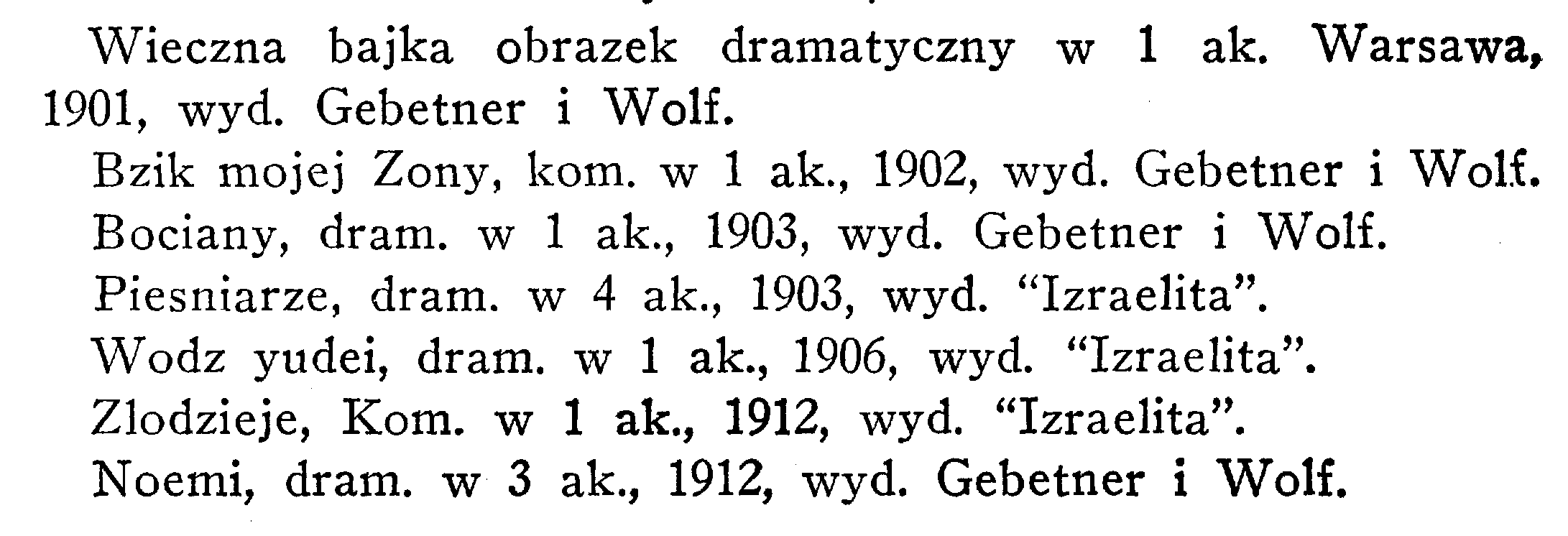
Polish:
In
Spanish:
Cuando
las Hojas caen. Nocturno dramtico, 1923, "Mundo
Izraelito," Buenos Aires.
La
Lagrima de Dios. Cuento para adultos, 1923. "Vida
Neustra," Buenos Aires.
Cuando
el diablo rie. Boceto dramtico, 1923. "Israel,"
Buenos Aires.
In English:
The
Eternal Song, One-Act Plays from the Yiddish, 1923.
Stewart Kidd Publishers, Cincinnati, U. S. A.
Sh. E.
-
Zalmen Reyzen -- "Lexicon of Yiddish
Literature," Vol. I, pp. 168-171.
-
B. Gorin -- "History of Yiddish Theatre," Vol.
II, "List of plays."
-
B. Gorin -- "History of Yiddish Theatre," Vol.
II, p. 214.
-
M. Y -- L. -- Mark arnshteyn in varshe, "Yidish
bine," Warsaw, 3, 1924.
-
Mark Arnstein -- Vi azoy ikh bin gekumen tsu der
bine, "Teat. tsayt," Warsaw, 4, 6, 1928.
-
Mark Arnstein -- Shpilstn a "tsadik" -- shpil
ikh "khasidim," "Teat. tsayt," Warsaw, 8, 1929.
-
Dr. Michael Weichert -- Unzere menus tsu mark
arnstein, "Literarishe bleter," Warsaw, 28,
1928.
-
Mark Arnstein -- Ir zent gerekht, khver
veichertn, "Literarishe bleter," Warsaw, 31,
1928.
-
"Dos sholem-aleichem-bukh," New York, 1926, pp.
205-6.
-
Elchanan Zeitlin -- Mak arnshteyn, "Teat. tsayt,"
Warsaw, 6, 1928.
-
Zalmen Zylbercweig -- Mark arnstayns epizoden
fun yudishen teater, "Lubliner togblat," 27 July
1928.
-
Geshikhte fun di yidishe teatern in varshe,
"Teat. tsayt," Warsaw, 1, 2, 5, 7, 1928.
-
Moshe Blecher -- Mark arnstayn oyffirung fun
leiviks "golem" oyf yidish, "Teat. tsayt,"
11-12, 1929.
-
Elchanan Zeitlin -- Mark arnshteyn, "Unzer
ekspres," Warsaw, 22 February 1929.
-
Michael Weichert -- "Teater un drame," Warsaw,
I, pp. 71-76.
-
B.Y. Goldstein -- "Der vilner balebestel," "Der
tog," N. Y., 12 October 1923.
-
L. Kesner -- "Vilner bel hbit'l" in iving plays,
"Idishes tageblat," N. Y., 12 October 1923.
-
Olgin -- Zitsendig in teater, "Frayhayt," N. Y.,
12 October 1923.
-
Yoel Slonim -- "Der letster moshikh" fun mark
arnshteyn, "Di varhayt," N. Y., 11 February
1914.
-
Joel Entin -- Mark arenshteyn's "a idishe
tokhter" in lobel teater, "Di varhayt," N. Y, 20
January 1914.
-
Jonas Turkow -- Yidish teater in yidish,
"Literarishe bleter," Warsaw, 33, 1929.
-
Mark Arnstein -- Vi ikh ze dos... "Literarishe
bleter," Warsaw, 35, 1929.
-
Jonas Turkow -- Di "kemfer" far yidisher kultur,
"Literarishe bleter," Warsaw, 36, 1929.
-
Mark Arnstein -- Klore dvurim, "Literarishe
bleter," Warsaw, 39, 1929.
-
A. Grafman -- A ridl zamd, "Literarishe bleter,"
49, 1929.
|