|
In 1904
A. began his dramatic activity. He published his
play "Tsurik-gekumen (Coming Back)" under the name "Itsa
ukhazar" in "ha-Shiloah (Sender)" 1904, and at the same time in
Yiddish in Peretz's "Yudishe bibliotek," 1904, the
play was subsequently published under the title
"Mitn shtrom (With the Current)" (publisher
"Progress" 1909). The two-acter soon was staged in
Yiddish and in Hebrew by various amateur groups, and
A. alone performed "Dovid" in one of several
productions in the Peretz-Herman dramatic studio.
Also,
later the play was included in the repertoire of
professional troupes.
On 9
January 1905 the play was staged in Polish in
Krakow's city theatre, and then on the Polish stage
in Warsaw.
The
second play, which A. published, is his drama "Moshiakhs
tsaytn (The Time of the Messiah)," that was
previously printed in Vilna's "Nayer veg," and then
it was printed separately ("Moshiakhs tsaytn -- A
Dream of My People" -- publisher "Tsukunft," Vilna,
1906). The play was rarely performed by professional
Yiddish theatre. The only productions of it that are
known are that of Adler in New York, and by Mestel
and A. Lubetsky in Vienna's "Yiddish Stage."
However, the play for a certain time was very often
found on the posters of the various Yiddish dramatic
amateur societies. The play under the name "Na puti
v'sion" was staged on 12 February 1906 in the
Russian translation by Yevgeni Tropovsky in
Peterburg, in Komissarzhevskaya's troupe; 15 July
1906 the play was performed in the Polish
translation of F. Sokolow on the Warsaw Polish
stage.
In 1907
A. published his drama "Got fun nekome (God of
Vengeance)," which soon was included in the
repertoire of professional Yiddish theatre and also
in amateur circles in the entire world. The main
role "Yekl Shapshovitsh" in America was performed by
Kessler, in Europe by Meyerson.
The
subject of the play had called out for a great
discussion in the press, and several times it even
went further, that certain Yiddish elements,
especially the sacred, had tried to be performed
within the play, declaring them as immoral. David
Frishman had in the "Theatre World" 1, 1908,
published a parody of he play under the name of "Got
fun rakhamim (God of Mercy)." A.'s drama was
performed in several European languages, such as
Russian, German (by Reinhardt, the role "Yekl
Shapshovitsh -- Rudolph Schildkraut, who performed
it later in America also in Yiddish), Polish (one
act in the translation of Dr. Gottlieb, staged in
the Polish [now Slavotski] city theatre in Krakow,
on 27 December 1908 it was staged by Karol
Adventovitsh in Warsaw, then in various other Polish
troupes; French (in the translation of L. Blumenfeld),
in English and in Italian. The English production
with Rudolph Schildkraut in the main role, was
forbidden by New York City's police, and the troupe
was arrested and judged innocent. The Hebrew
production in Eretz Yisrael was not derlozt.
In the
"Literary monatshriftn" (III, 1908), A. published
his historical tragedy "Shabse tsvi," the tragedy in
the adaptation of Joseph Buloff was staged in 1926
by the "Vilna Troupe" in Rumania, indicating on the
poster as the basis for the first and third act of
the play of Asch's "Shabse tsvi," and the second and
fourth acts of Zhulavsky's "Der suf fun moshiakh
(The End of the Messiah)." The play in the same form
also was staged in 1928 in the "Yiddish Dramatic
Literary Society" in Chicago. Both productions were
directed by Joseph Buloff, who performed in the
title role. The same play in 1928 was also staged in
Riga's "New Yiddish Theatre" by A. Stein, who
performed in the title role.
Circa
1908 A. also wrote his one-act play "Amnon and
Tamar" (staged on 30 June 1919 by Granovsky's Studio
in Petrograd, Director A. Granovsky, music Rozovsky,
and on 27 March 1921 by the "Vilna Troupe,"
Director: Mendel Elkin), "Um vinter (Around Winter)"
(staged on 30 June 1919 by Granovsky's studio in
Petrograd, Director A. Granovsky, music Krein) and
"Der zindiker (The Sinner)" (staged on 28 June 1919
by Granovsky's studio in Petrograd, director
Granovsky, music Rozovsky, and on 27 March 1921 by
the "Vilna Troupe," Director Mendel Elkin).
In 1909
A.'s published the comedy "Yikhes" [at first printed
in the collection "Di yidishe yugend," Warsaw, Tr"e,
59 p., 8°]. The play was soon included in the
repertoire of the amateur circles, and for a short
time after it was published, it was staged under the
providence of the author and the director for Julius
Adler, by Zandberg's troupe in Lodz's Grand Theatre,
in February 1921 the play was staged in New York in
the New Yiddish Theatre, and then by other troupes.
Soon
after the play was published, it was read by the
author for a Russian translation in a circle of
Russian playwrights and artists in Peterburg, and it
served as a cause for the well-known
Chirikov-Arabazhin scandal.
At the
end of 1909 A. visited America, and there he wrote a
comedy of Jewish life in their new home "Der
landsman" (staged by Kessler). The play did not have
great success. also the production in Europe (Julius
Adler in Lodz's Grand Theatre) hadn't any success.
Then the Vienna production of the play with Max
Shtreng in the title role in the "Fraye yidisher
folksbine" (1919, Director Jacob Mestel), was a
great success.
The
comedy also was the first play with which the "Vilna
Troupe" began its activity.
Several
years later in Lodz's Polish theatre, the comedy was
staged in Polish by Tatarkovich.
In the
span of the years 1910-14, A. published, among his
many fictional works the following theatre pieces:
the pre-historic, biblical drama "Jephthah's
Daughter" (publisher B. A. Kletzkin 1913), the
two-act drama of Polish artistic life "Der bund fun
di shvakhe" ("Di yidisher velt," Peterburg 1912, I
-- II).
In 1916
A.'s drama "Dos heylike meydl oder a shnirl perl"
was published (staged on 10 December 1925 in New
York's Yiddish Art Theatre), in 1920 A.'s drama "Der
toyter mentsh" [staged on 13 January 1922 by the
Chicago Literary Dramatic Society, Director Abraham
Teitelbaum, and on 2 February 1922 in New York's
Yiddish Art Theatre, Director Schwartz], A.'s
published "Maranen."
On 15
March 1917 in New York's Second Avenue Theatre,
there was staged with Kessler in the title role A.'s
drama "Motke ganef (Motke the Thief)" (dramatized by
the author from his drama of the same name). The
same drama was staged in 1921, which the author
attended in Poland, in Warsaw's Central Theatre,
with A. Samberg in the title role, and was the hit
of the Yiddish theatre, enduring several hundred
performances in Warsaw, and going over to all the
Yiddish stages in the province. The drama also later
was performed in Hebrew in Eretz Yisrael.
On 1
March 1918 there was staged in Adler's Grand Theatre
by Adler (Adler performing the role "Hersh Leib the
Coach Owner"), Asch's play "Ver iz der tate (Where
is the Father?)" [special for the purpose of the
free adaptation by the author of his play "Bund fun
di shvakhe"]. Then the folk-shtik "Far unzer globyn"
was performed (performed by various Yiddish
troupes).
In
January 1924 A. published in "Tsukunft" fragments of
his biblical drama "Joseph," a shepherd's story in
five scenes, and in 1928 A. published in "Haynt"
fragments of the same drama.
On 3
March 1927 New York's Yiddish Art Theatre Schwartz
staged (for his benefit) A.'s drama "Reverend Dr.
Silver," which was however performed a few times.
On 2
May 1928 in Warsaw's Elizeum Theatre, there was
staged by the "Vilna Troupe" the dramatization of
A.'s historical novel "Kiddush Hashem" [assembled
for the stage in twenty-five scenes by Michael
Weichert, Director M. Weichert, music Kh. Cohen,
scenery W. Weintraub]. The production had a huge
success, and in Warsaw alone was performed around
two hundred times. On 16 September 1928 M. Weichert
directed the same play with a fully new personnel in
the new Yiddish theatre in Riga, Latvia.
On 14
September 1928 "Kiddush hashem" was staged in New
York's "Yiddish Art Theatre" in Schwartz's
dramatization and direction. In the same year
through the "Culture League" publishing house in
Warsaw, A.'s four-act drama "Koyln" [two acts
previously printed under the name of "Di kind fun
the erd (The Child of the World)" in "Tsukunft," 1,
2, 1922].
In 1929
in the "Oysgabe avtorn (author's edition)," Minsk,
there was published: "Uncle Moses," a play in three
acts -- fourteen scenes (according to Scholem Ash)
by Y. Mlinek and H. Fafak [64 pp., 16°].
A.'s
dramatic work in Yiddish are:
-
Sholem Asch. Collected scripts. Volume 15.
Publisher "Culture League," Warsaw. Dramatic
Script. (Biblical and historical drama) Volume I
[Contents: "Jephthah's Daughter," 60 pp, 16°;
"Shabse tsvi," a tragedy in three acts and six
scenes with a prelude and postlude, 88 pp., 16°;
"Amnon and Tamar," a dramatic song in five
gezangen, 73 pp., 16°].
-
D.
Z. Volume 16. Dramatic script. (a social drama)
Volume II. [Contents: "God of Vengeance," a
drama in three acts, 96 pp., 16°; "Der bund fun
di shvakhe," a drama in three acts, 63 pp, 16°;
"Motke the Thief," a folks-shtik in three
acts with a prologue, 85 pp., 16°; "Yikhus," a
comedy in 3 acts, 93 pp., 16°].
-
D.
Z. Volume 17. Dramatic script (national drama)
Volume III [Contents: "Moshiakh tsaytn," a tsayt-shtik in
three acts, 75 pp., 16°; "Unzer gloybn," a folks-shtik in
four acts, 82 pp., 16°; "A shnirl perl," a
tragedy in four acts with a prologue, 91 pp.,
16°; "Der toyter mentsh," a drama in three acts,
84 pp., 16°].
-
D.
Z. Volume 18. Dramatic script IV. [Contents: "Di
yurshim," a drama in four acts, 106 pp., 16°;
"Mitn shtrom (With the Current)," a drama in two
acts, 34 pp., 16°; "Der zindiger (The Sinner)"
in two scenes, 37 pp.; "Um vinter," 30 pp., 16°;
"Maranen," a shtik in one act and two
scenes, 32 pp., 16°].
-
Sholem Asch. "Koyln," a drama in four acts,
publisher "Culture League," Warsaw, 1928 [112
pp., 16°].
In Hebrew:

In Russian:
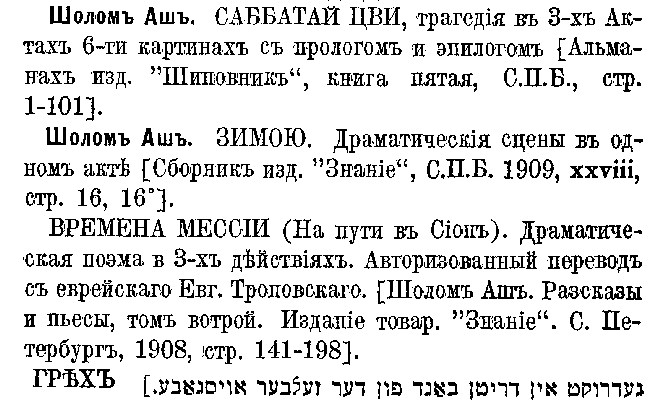
[printed in the third volume of the same edition.]

[printed in the third volume of the same edition,
1909, the edited translation by Sh. Frug, pp.
195-226, previously printed with a small change in
the twenty-first volume of the same book, "Znanye,"
1908].

"God of Vengeance," publisher "Velt-bine." "Far
unzer gloybn." "Moshiakhs tsaytn," translator A.
Shultz.
In English:
-
THE
GOD OF VENGEANCE -- (In: East and West, New
York, 1915, v. 1, p. 324-340).
-
THE
GOD OF VENGEANCE -- Drama in three acts by
Sholom Ash, Authorized translation from the
Yiddish with introduction and notes by Isaac
Goldberg, Preface by Abraham Cahan, Boston, The
Stratford Co., Published MCMXVIII (pp. 99, 24°).
-
WITH THE CURRENT -- (East and West, New York, v.
1, p. 195-199).
-
THE
SINNER -- (East and West, New York, 1915, v. 1,
p. 5-9. Also criticism by John Erskine, ibid.,
p. 21-23).
-
THE
SINNER -- (In: I. Goldberg's Six Plays of the
Yiddish theatre, Boston, 1916, p. 75-78.)
-
JEPHTHAH'S DAUGHTER -- (East and West, 1915, v.
1, p. 108-117.)
-
WINTER -- (In: I. Goldberg's Six Plays of the
Yiddish theatre, Boston, 1916, p. 123-150.
Review by "Lucifer" in Jewish Chronicle, London,
May 27, 1927, p. 34).
[The English translation was registered,
according to the public library on 42nd Street,
New York].
In German:
-
SABBATAI ZEWI, Tragödie in Drei Akten (Sechs
Bildern) Mit einem vorspiel und einem Nachspiel,
von Schalom ash. S. Fischer Verlag, Berlin,
1908, [134 pp., 24°].
-
DIE
FAMILIE GROSSGLUCK, Komödie in drei Akten, von
Schalom Asch, S. Fischer Verlag, Berlin, 1909,
[134 pp., 24°].
["Yikhus," translation by Pavel Barkhan,
Reyzen's "Lexicon," Vol. I, p. 226].
-
DER
SÜNDIGE,
Drama in einem Aufzug, übertragen von Alexander
Eliasberg, Georg Müller Verlag, München, 1919.
[In the second volume of Eliasberg's "Yidishem
teater," 22 pp., 16°].
-
MIT
DEM STROM, Drama in Zwei Aufzüg, übertragen von
Alexander Eliasberg, Georg Müller Verlag,
München, 1919.
[In the second volume of Eliasberg's "Yidishem
teater," 51 pp., 16°].
"Amnon and Tamar," translation by Sh. Frug,
printed in a collection by the Peterburg
Publishing House, "Znanye," 1909.
"Belaya kost" ["Yikhus"].
"Der bund fun di shvakhe."
In Polish:
-
"Tsurikgekumen" [Mitn shtrom], printed in a
journal, ed. of St. Zheromski.
"Got fun nekome."
"Moshiakh's tseytn," translation of P. Sokolow.
In Rumanian:
-
SCHALOM ASCH, Dumnezeul Razbunarii, Drama in 3
acte, Tradusa din idis, de: Schoss-Roman si
Cidel-Roman, Bucuresti, 1928, [pp. 79, 16°].
-
Z. Reyzen -- "Lexicon of Yiddish Literature,"
Vol. I, pp. 173-86.
-
B. Gorin -- "History of Yiddish Theatre," Vol.
II, pp. 211, 214, 218, 253, list of plays.
-
Jacob Gordin -- Ale shriften, fierter band, N.
Y., 1910, pp. 167-171.
-
David Frishman -- Shriften, 3ter band, pp.
66-67.
-
S. Dubnow -- Erlich -- Sholem asch "got fun
nekome" oyf der bine fun teater "niezalezshni,"
"Fts"t," Warsaw, 9 July, 1926.
-
I. Manger -- Shabtai tsvi, dramatishe misterye
in 3 aktn fun ash un zhulavsky, "Ov-vort,"
Bucharest, 18, 1926.
-
S. -- Shabtai zvi, "Arb"tst," Czernowitz, 211,
1926.
-
Shakhna Epstein -- "Got fun nekome" un unzere
naye got's straptshes, "Frayhayt," 13 January
1926.
-
Michael Weichert -- "Teater un drame," Warsaw,
I, pp. 76-94.
-
Lead Pencil -- Vi azoy dos "verte publikum" git
aroys an urteyl oyf a piese, "Forward," 6 March
1918.
-
Ab. Cahan -- A naye drama fun sholem ash,
"Forward," 5 March 1927.
-
A. Eynhorn -- Sholem ash naye drama revrend dr.
zilber, "Literarishe bleter," 2, 1927.
-
Dr. Michael Weichert -- Mayn instsenizirung fun
sholem ash, "kiddush hashem," "Literarishe
bleter," 9, 1927.
-
HERMAN KIENZL, "Die Bühne Ein Echo der Zeit,"
Berlin, (1907) [pp. 231-235.]
-
Ab. Cahan -- Sholem ash's "der yikhus" in dem
nayem teater, "Forward," 15 Febuary 1921.
-
Moshe Nadir -- "Mayne hent hobn fargosn dos blut,"
pp. 140-4, 161-165.
-
Dr. Y. Shifer -- Premiern in "tsentral," "yidish
teater," Warsaw, 1922, IV- V.
-
Sholom Fraynt -- Dos ershte yidishe
gezelshaftlekhe teater in poyln. "Yidish teater,"
Warsaw, II.
-
Ab. Cahan -- "Kidush hashem" in shvarts' kunst
teater, "Forward," 22 September 1928.
-
N. Mayzel, A. Kacyzne -- Sholem ash "kidush
hashem" bey der vilner trupe, "Literarishe
bleter," 19, 1928.
-
N. M. -- Di hundertste forshtelung fun ash "kidush
hashem," "Literarishe bleter," 30, 1928.
-
Michael Weichert -- Sholem ash un dos yidishe
teater, "Literarishe bleter," 85, 1925.
-
Dr. Y. Vortsman -- "Ver iz der tate?," "Tog," N.
Y., 11 March 1918.
-
Yoel Slonim -- "Motke ganev" in theater, "Di
varhayt," N. Y., 24 March 1917.
-
J. Entin -- "Ver iz der tate?" in adler's teater,
"Di varhayt," N. Y., 6 March 1918.
|

