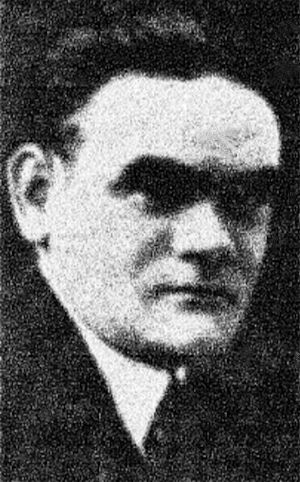
|
Until 1912 he toured
across Russia. From 1912-14, with various itinerant
troupes across Poland. In 1915 he sang couplets in
cabarets and theatres. From 1916-20 he played in
Lita, then returned to Poland, where he continued
acting and was a member of "Unzer Theatre" in Vilna.
In 1930 he was in
Vilna to celebrate his theatre anniversary.
Jonas Turkow in his
portrayal of Morris Lampe:
Morris Lampe in the
war years of 1914-1917 had a colleague with whom he
used to perform in all of the shows and concerts
that they arranged -- it was Max Pokoy [M.
Maksimov]. He was a house painter. Lampe and Pokoy
were not any kind of professional actors, but
amateurs. They performed in all the Warsaw wedding
halls, toured as "guest players" in the summer
apartments of the Warsaw area, in several
'residences,' such as Jablonna, Falenica, and so
on., and even though they were still amateurs then,
not professionals, they were so mobile that
everywhere their eyes were thrown off. Why did the
two men have such a pathetic relationship is a
secret to me this day. Perhaps take note of the fact
that their looks were so catastrophic and were
thrown into their eyes.
"Max Pokoy was, on the
contrary, to Lampe, a little farther away, with a
brighter, flashier nose, like a half-cut potato,
with little pointed eyes, had struck a flood, and
incoherent temperament. Pokoy, on the contrary, was
a calm one, sedate person, speaking slowly and
walking across the streets as if he was in no hurry.
Indeed, one had to laugh when one saw the pair of
Pokoy and Lampe along the streets. Lampe laughed,
always a few steps ahead, and he spoke for him,
meaning that he gave himself up to his partner. He
gave himself to his businessman, who walked slowly
behind Lampe and didn't hear his words. When Lampe
remarked that he gets no response. He turned, and
seeing that Pokoy continually standing behind him,
he ran to him and scolded him, throwing it with his
head and hands. [awk]
...During the German
Occupation in the year 1916, when people again were
permitted to play Yiddish theatre, Morris Lampe,
together with his partner Pokoy, think this might be
"Like in Paris" -- so the cinema was called -- on
the first floor of Djike (sp) Street 12. There Lampe
staged "Mendel Beilis Trial"... In the production
among others, also Max Poloy participated. ...That
evening the theatre was oversold to the last seat,
so that the troupe began to play twice a day.
'Mendel Beilis' went on for months."
According to Turkow M.
also played in the former wedding hall in Warsaw on
Djike 29 during the First World War.
About M.'s tragic end
there is little information:
According to Jonas
Turkow in his description of Morris Lampe, that the
two friends had, during the Second World War,
happened to be in 1940 in Grodno, where Lampe
founded a Yiddish theatre collective, and together
they found the martyr's death.
Sh. Kacerginski
detailed in short: "Maksimov, a well-known actor,
Ponar, 1941."
And in another place
he mentions: " Pokoy -- artist. In 1940-41
administrative head of the Yiddish war theatre in
Vilna. Shot at the beginning of July 1941."
-
"Lexicon of the
Yiddish Theatre," Warsaw, 1934, Volume 2, pp.
1240-41.
-
Sh. Kacerginski
-- "The Destruction of Vilna," New York, 1947,
p. 229.
-
Jonas Turkow --
"Extinguished Stars," Buenos Aires, 1953, Vol.
1, pp.296, 297, 300; Vol. 2, p. 236.
|