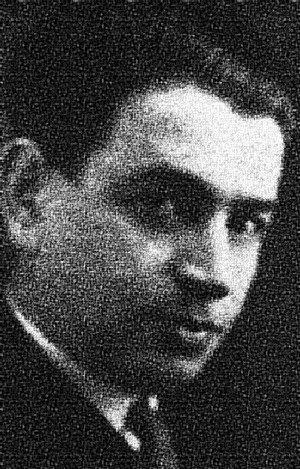
the
operetta repertoire for his
father-in-law, Moshe Ziegler's
troupe, with whom he went across
Austria and Hungary with, as well as
Czechoslovakia, Poland and Romania.
Zalmen
Zylbercweig, who had happened [p'n]
in 1928 in Ziegler's troupe, recalls
that he was very popular with the
theatre audiences. He truly
exhibited himself as a fine
fat-lover, a good dancer and as a
knowledgeable regisseur oyftsufirt
oyf a sheynem ufn operetn under
the difficult conditions of an
itinerant troupe, often across small
cities and towns on geherike
aksesarn, as the necessary
decorations, lighting, chorus,
dancers, orchestras and tools with
which operetta productions were
associated [?]
According to Julian Schwartz, the
Ziegler troupe was found in Austria
when the country became occupied by
the Nazis. The troupe soon
thereafter was forced to go to
Romania, but P. as a Polish citizen,
was taken by the Nazis to Poland,
where he was killed.
Sh. E. from Zalmen Zylbercweig and
Julian Schwartz.
-
"Lexicon of the Yiddish
Theatre," New York, 1959, Vol.
III, p. 1942.