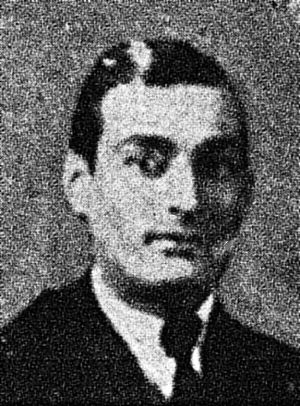
|
"calendar," he too to writing songs and
music for Yiddish theatre (especially
for Saltche Weinberg and Pepi Littman), git
oyf the badkhans and became a
conductor in Ber Hart's provincial
troupe, where he also wrote music for
the songs in the performed operetta.
His first
composition to a complete operetta was
for Lateiner's operetta "Khosn-kale
(Groom and Bride)" (performed in New
York with couplets, by Mogulesko, and
music by Friedsel), staged in Krakow
under the direction of Yidl Gutman.
By
accident he filled a role in the
troupe), giving him the role to play of
"Shemai" in Gordin's "Jewish King Lear,"
and since then he has remained an actor,
spending less time with orchestral
conducting.
In 1910 he
became the conductor of the national
Ukrainian theatre "Besida," but soon due
to family concerns, he left and took to
traveling with provincial troupes across
Galicia and then, together with K. M.
Ebell, went off to Argentina, where he
wrote in "Yidisher soykher (Jewish
Merchant)."
In 1912 he
performed as a comic and regisseur under
Meltzer's direction in Romania, and he
also participated with Dina Feinman in
Gordin repertoire.
During the
Romanian-Bulgarian war, he was expelled
as an alien from Romania, and he
returned to Galicia, where he performed
with small breaks in the troupe of
Glimer and his brother Jacob Prizament,
until the outbreak of the First World
War.
As a
soldier he was active on the Russian and
Italian fronts, and in 1918 he arrived
in Vienna, where he opened the "Bemishn
Haf," a Yiddish theatre, and there he
staged his play "The Destruction of
Lemberg." Due to a denunciation, he lost
his concession to perform, and he
traveled to Budapest, where he became
during the Bela-Kuhn period,
Commissar of the Jewish worker's stage,
and afterwards he united with the troupe
of Shtramer, Rabinowitz, Vayts, Stein,
and performed there until the Horthy
government forbade Yiddish theatre. Now
he traveled, returning to Vienna and
opened there, under his artistic
management, a miniature theatre, where
he performed most of his things. Here he
also composed, together with Avish
Meyzels, the play "The Golem of Prague"
(Sh. Prizament and A. Meyzels. Der
golem. Play in three acts. Publisher Sh.
Goldfarb, Warsaw, 32 pp., 16°). In text,
it was given as a "musical legend in
four acts.)
In 1920 he
founded, together with Zachariah Francis
(sp) and Itzhak Mestel in Pressburg
(Bratislava), Czechoslovakia, the troupe
"HaOr" (see "Lexicon of the Yiddish
Theatre," V. 1, p. 572), which disbanded
in 1922.
In 1923 he
arrived in Poland, and there he founded
a troupe under the name of "HaOr."
However, after meeting Gizi Hajdn. who
became his wife, he organized another
troupe, and in 1924-1925 he founded,
along with Hersh Hart, a troupe for the
Galician province. In 1925 he
guest-starred in Warsaw in the
"Kaminska" Theatre, and there he stayed
for a season. At the same time he wrote
music and songs for the operetta "Di
galitsianer mume (The Galician Aunt[?])"
and for Moshe Richter's "Di tsvey
shvigers (The Two Mothers-in-Law)."
In 1927 he
joined the "Sambatiyon," where he
composed the music (and also several
songs) to Nozyk's revues, "Dirh-noyt,"
"Der rebe hot geheysn freylekh zayn,"
"Vu nemt men a khasen?" and "Nokh
havdalah." In 1928 he joined the
"Azazel-Sambatyon" ensemble as a musical
director, and after the disbanding of
the ensemble he traveled to Romania,
where he performed in the local Yidish
theatre (also in a revue theatre_ and
acted afterwards again in Vienna and
later in Poland.
In 1933 he
composed a play "In Hitler-Land," which
was performed in Warsaw's "Kaminska
Theatre."
In the
summer of 1938 he performed in Lemberg's
summer theatre in Richard Foss' play "Shrey,
Israel," and then associated himself
with the guest-starring troupe there "Vik't,"
for which he adapted the music to
Goldfaden's "Shulamis," which was put on
there in a new adaptation of Zygmunt
Turkow. About the music, Israel
Ashendorf writes:
"Shlomo
Prizament, with great prudence and love,
had created intermezzos, a part melody
combined with his, a part rhythmic and
adapted for dance. He played very much a
large part in the success of the
production."
P. also
adapted for the same troupe the music to
the modernized production of Goldfaden's
"Bar Kochba," about which Dr. Leib
Hammer writes:
"Shlomo
Prizament had preserved Goldfaden's
music to 'Bar Kochba," but farfeynert,
connected it together with rhythmic
sounds and created the music getrey the
Goldfaden-like soul to the new image,
which was first to come together."
Also a
production was advertised for a
Goldfaden play "Broder-Singer," adapted
by Israel Ashendorf with P.'s music.
P. has
composed the following plays:
"Lemberg
far der melkhome (Lemberg Before the
War)"; "A moyd fun provints (A Girl From
the Province/Sticks)," adapted from the
German, with music, which was performed
in Czernowitz, had translated "Muter un
tokhter (Mother and Daughter) by Paul
Hause, had writen music and songs to "Shloymele
Sheygets" by Shtshorgol, "Di blumen
kenigin" by Shtshogol, "Dos arendars
tokhter" by Leib Drucker, "Lah'kes mazel"
by Leib Drucker, "Dos kabaretn-meydl" by
Leib Drucker, and "Khli-zmr," after
Gurewitz, as well as illustrated music
to Sholem Asch's "Der toyter mensh,"
Peretz's "In polish oyf der keyt," Foss'
"Daniel Danieli," Dr. Fistner's "Dem
bel-shm's mufs," Kalmanowitz's "Eybike
naranis," "Moshe, vos krichstu?" and "Yukl
dem khazan's," to A. Nager's "Lustike
yugnt," and adapted and wrote music to 'Oyf
der shvel fun glik."
He also
composed several hundred songs and
couplets. The most popular of them were:
"Fannie's Mplh," "Davenen fun eyn
mkhzur'l," "Sha, Sha, der rebbe geyt"
(from which the music was, without the
knowledge of P.., used in a "musical
comedy" on Broadway), "A shpilekhl,"
"Moshiakh flit," "Der rebbe hoydet zikh,"
"Doktor shteynakh."
During the
Second World War, P. survived by
escaping to the Soviet Union.
M. E.
-
Y.
G. Sh. -- Fir -- A yidishe
operetn-trupe vos fardint a por
vareme verter, "Dos naye lebn,"
Bialystok, 22 March 1929.
-
L.
Dreykurs -- An'aktuele teaqter-piese
"In Hitler-Land," "Unzer ekspres,"
Warsaw, 11 May 1933.
-
Israel Ashendorf -- Di
shulamis-oyffirung baym "Vikt" in
lemberg, "Literarishe bleter,"
Warsaw, 1, 1939.
-
Dr.
Leib Hammer -- Premiere "Bar Kochba"
in "Vikt," "Literarishe bleter,"
Warsaw, 11, 1939.
|