|
"Mirele Efros"
ABOUT THE AUTHOR,
JACOB GORDIN (1853-1909)
Jacob Gordin was born
in Russia and settled in New York, where he wrote a
number of Yiddish plays. Encouraged by the success
of his first play, he continued to write original
plays, as well as adaptations from outstanding
European playwrights. Gordin's plays gave new life
to the Yiddish stage, and his fame reached both
Jewish and non-Jewish audiences. His more successful
original plays were "God, Man and Devil," "Mirele
Efros," "Elisha ben Avuyah," "The Yiddish King
Lear," "Kreutzer Sonata," and "The Slaughter." Two
volumes of selected plays were published under the
overall title, "Jacob Gordin's Dramas."
To modern audiences,
early Yiddish plays may seem ingenuous and overly
emotional, but these plays reflect a people who have
suffered long and have been subjected to all kinds
of cruelty and discrimination but have never lost
their dreams, hope and promise of a better day. The
people were real, and with a fast-growing world of
changed values they remained the same. Regardless of
what suffering they had to endure, a day of justice
and a better life were always "around the corner."
SYNOPSIS OF "MIRELE
EFROS"
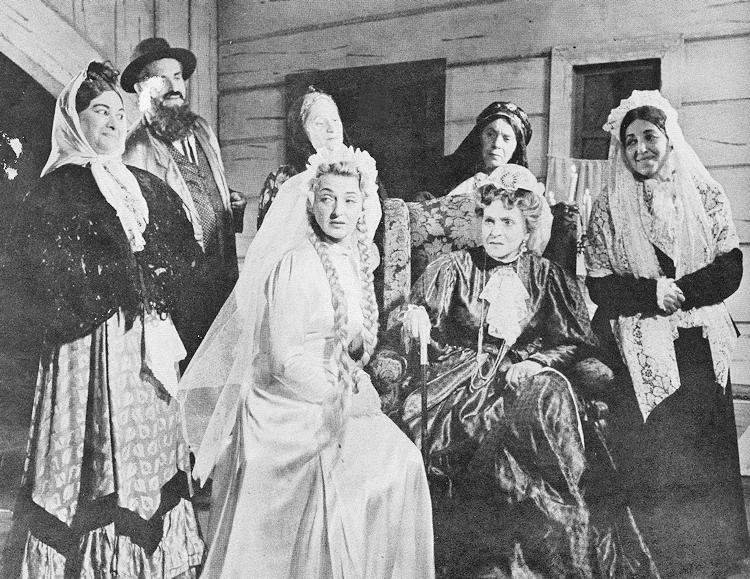
ACT 1 -- IN SLUCK
The second half of the
nineteenth century: Mirele Efros, a rich widow from
Grodno, well-known for her independence and common
sense visits the small town, Sluck with a large
entourage consisting of her maid, Machle, her
trusted administrator, Reb Szalmen and members of
the Efros family. The journey was to find a bride of
a respectable but poor rabbinical family for Josele
Efros. As the plans for the marriage with Szejndele
are discussed with her parents, Chane Dwojre, the
daughter of a famous rabbi and Reb Nuchemce, Mirele
is unhappy about the extravagant demands made by
Szejndele's parents and threatens to break the
engagement. Josele, who knows Szejndele only through
her photograph has lost his heart to her, pleads
with his mother not to break the engagement. Mirele,
who has always tried to make their children happy,
agrees to the marriage arrangements and asks for an
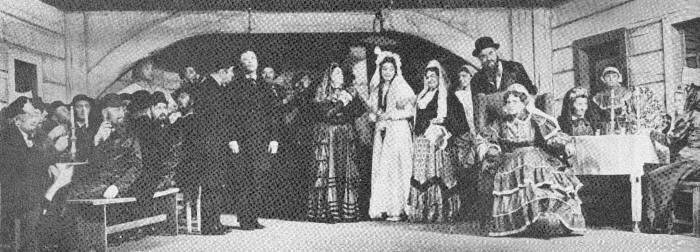
immediate wedding. Preparations are made and large
donations are made to charity (some fictitious), as
is the custom. Szejndele's beauty, modesty and good
sense have won Mirele's favor. The wedding is held
out-of-doors, and the entire town is invited.
ACT II -- IN GRODNO
THREE YEARS LATER
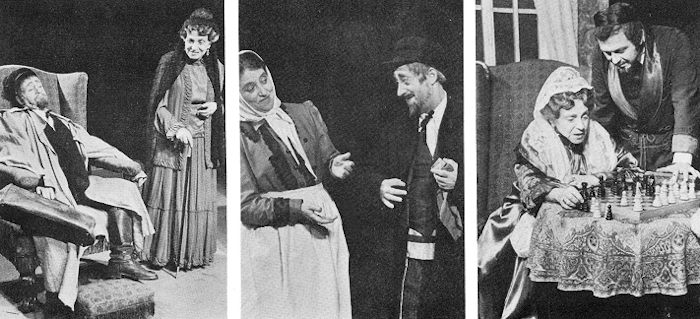
On a Saturday evening
at the Efros home where the newlyweds live, Mirele
tells Machle that she is indulgent toward Szejndele
because of Josele's great love of her. As Szalmen
comes to settle his weekly business, Chane Dwojre
insinuates that Szalmen is cheating the family
because Mirele is too trusting, and as an "old
woman" she is no longer capable of running the family
business and suggests that the young couple assume
control. Szejndele enlists the aid of Donie,
Josele's bolder brother, to help her make demands of
Mirele. Szalmen insists that although he has
accumulated a good deal of money, this was done
honestly and that he would never hurt Mirele in any
way. An investigation made as to the value of the
estate left by the head of the Efros family leads to
the knowledge that there were only debts, and that
the business was completely bankrupt. Only Mirele's
astuteness, ingenuity and hard work for eighteen
years have built up the family fortunes. Mirele is
disturbed by her children's distrust, and while
alone reads David's psalm "... I sink in deep mire,
where there is no standing: I am coming into deep
waters, where the floods overflow me."
ACT III -- IN
GRODNO
 |
|
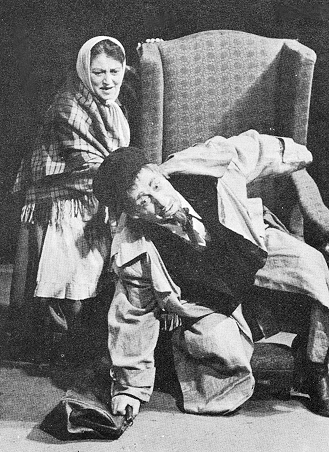
Nuchemce, now the
family administrator, has returned from a business
trip in a drunken state and is incoherent about
the receipts and says that he has put down all his
accounts in an "old prayer book." Donie, who has
returned from Riga, cannot explain his vast
expenditures and suggests that Szalmen again run the
business. Josele is sure that Szalmen would work
only for Mirele, and as a quarrel continues Mirele
arrives. She is shocked to see Szejndele wearing her
jewelry, and as Szejndele is reprimanded for this,
she retorts, "Mirele is not going to wear them
forever anyway."
When delegates come to
ask for a donation for charity from the once rich
Mirele, she offers a donation. Her children refuse
her the money, and Machle offers to help from her
hard-earned savings. When Mirele refuses to take
Machle's money, Szalmen pays the amount offered by
Mirele. As Machle relates to Szalmen the corruption
in the Efros house, Szejndele overhears and attempts
to strike Machle. This is as much as Mirele can
bear. She asks Szalmen if she can live at this home
and also help him in his business.
In spite of the
pleadings from Josele and Szejndele that Mirele's
leaving would create a scandal, she is adamant and
leaves her own home saying: "... thirty years ago I
came to this house full of expectations, and now I
am leaving deprived of all hopes and illusions." |
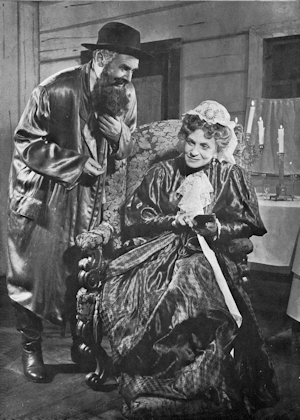
ACT IV -- TEN YEARS
LATER
 |
|
After ten
years at Szalmen's house, the rabbi's
attempts to persuade Mirele to return to
her own home, and even Josele's pleading
with her to return for the occasion of
his son's thirteenth birthday, have come
to naught.
Szejndele
too comes to plead and relates to Mirele
that from the moment she entered the
Efros' home, she felt humiliated because
of her own poverty, which caused her
untoward behavior toward Mirele.
In spite
of Szejndele's apology, Mirele cannot
return from her voluntary "exile," which
she did for the "sake of the children."
Each one "... acts in the way he
thinks , but one should think how to act ..."
Where his
parents have failed, their son Szlojmele
succeeds in winning his way to his
grandmother's heart.
Mirele
agrees to return to her children, and
all are happy about the reconciliation,
except Szalmen (although he respects
Mirele's maternal feelings), who will
find his home empty without Mirele. |
|

